Command Systems
Created by Commodore Wilkan Targaryen on Sat Dec 21st, 2024 @ 1:18pm
Main Bridge
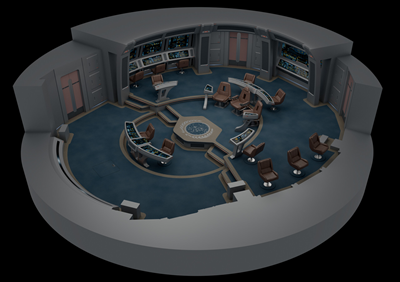 If Main Engineering is considered the heart of the starship, the Bridge serves as the Enterprise's brain and operational nerve center. Located at the apex of the Saucer Module on Deck 1, the Main Bridge coordinates hundreds of thousands of simultaneous processes, ensuring all mission protocols are achieved. As the primary command center, it is one of the most secure and collaborative locations aboard the vessel, constantly manned by trained personnel who manage supervisory duties from specialized workstations. While Starfleet bridge design has remained relatively consistent for over three centuries, the modern Century Class reflects an evolution from the austere, militaristic, and cramped conditions of the 22nd Century NX Series and the isolated styling of the Constitution Class to a more integrated and comfortable environment.
The command area at the center of the bridge features a sophisticated seating arrangement for the vessel's senior leadership. Reflecting a philosophy of collaborative command popularized by the Galaxy and Intrepid Classes, the Captain’s chair is no longer isolated but is instead flanked by dedicated stations for the First Officer and other mission-critical personnel. Directly ahead of this command group are the Flight Control (Conn) and Operations Manager (Ops) stations, which face a massive, high-definition viewscreen. This viewer serves as the primary visual interface for the ship, capable of displaying sensor readings, optical scanner output, or holographic communications via a dedicated subprocessor. Each workstation on the bridge incorporates a flat, touch-sensitive interface (an advancement from the physical buttons of the 23rd century) supplemented by built-in holographic emitters and status displays.
The perimeter of the bridge is lined with specialized duty stations. These stations are supported by an extensive network of computer optical subprocessors housed in sealed equipment bays behind the aft consoles and beneath the deck structure. Connectivity is maintained through multiple optical data network (ODN) trunks, electro-plasma power waveguides, and service crawlways. Because of its critical role, the Bridge is designated as a primary emergency environmental support shelter. Protected by specialized utility trunks and emergency atmospheric modules, the bridge can maintain Class M conditions for up to 72 hours and provide independent lighting and atmosphere for an additional 24 hours even in the event of a total failure of the ship's primary and reserve life support systems.
Physically, the Main Bridge is a modular structure, a design philosophy that allows the entire command shell to be removed and replaced during a starbase maintenance cycle to facilitate rapid technology upgrades. The Cridge shell is constructed from an interlaced microfoam-duranium filament gamma-welded to a tritanium truss framework. Torsion relief is provided by microfoamed ceramic gaskets that dampen vibrations between the structures. On Century Class vessels, this module is integrated into the Deck 1 superstructure and is flanked by essential support facilities. These adjoining rooms, along with the bridge itself, are equipped with food replication terminals and emergency medical supplies, ensuring the command team remains functional during extended crises.
For a detailed tour of the Enterprise's Main Bridge, please visit: U.S.S. Enterprise Main Bridge.
Main Bridge Duty Roster | ||||
07:00 - 13:00 |
13:00 - 19:00 |
19:00 - 01:00 |
01:00 - 07:00 | |
| Command | Commanding Officer* | Executive Officer* | Senior Staff Designee | Senior Staff Designee |
| Engineering** | Chief Engineering Officer* | Assistant Chief Engineering Officer |
Engineering Officer | Engineering Officer |
| Flight Control | Chief Flight Control Officer* |
Assistant Chief Flight Control Officer |
Flight Control Officer | Flight Control Officer |
| Operations | Chief Operations Officer* | Assistant Chief Operations Officer |
Operations Officer | Operations Officer |
| Science | Chief Science Officer* | Assistant Chief Science Officer |
Science Officer | Science Officer |
| Tactical | Chief Security/ Tactical Officer* |
Assistant Chief Security/ Tactical Officer |
Security/Tactical Officer | Security/Tactical Officer |
Notes | ||||
| * - Despite having a scheduled time of duty, this crewmember is considered on-call. ** - Workstation manned on an as needed basis. | ||||
Main Bridge Duty Roster (Separated Flight) | ||||
07:00 - 13:00 |
13:00 - 19:00 |
19:00 - 01:00 |
01:00 - 07:00 | |
| Command | Executive Officer* | Officer Designee | Officer Designee | Officer Designee |
| Engineering** | Chief Engineering Officer* |
Engineering Officer | Engineering Officer | Engineering Officer |
| Flight Control | Assistant Chief Flight Control Officer* |
Flight Control Officer | Flight Control Officer | Flight Control Officer |
| Operations | Chief Operations Officer* |
Operations Officer | Operations Officer | Operations Officer |
| Science | Chief Science Officer* | Science Officer | Science Officer | Science Officer |
| Tactical | Assistant Chief Security/ Tactical Officer* |
Security/Tactical Officer | Security/Tactical Officer | Security/Tactical Officer |
Notes | ||||
| * - Despite having a scheduled time of duty, this crewmember is considered on-call. ** - Workstation manned on an as needed basis. | ||||
Combat Information Center
 While the Century Class Enterprise is built with a unibody construction, it is fully engineered to engage in separated flight mode, a procedure that detaches the primary hull from the secondary engineering section. During this saucer separation, the vessel functions as two distinct spacecraft; the saucer section remains under the command of the Main Bridge, while the engineering section is controlled from the Combat Information Center. Although more commonly known as the Battle Bridge, the Combat Information Center serves as the primary tactical command and control hub for the Stardrive or Battle Section. While smaller and more functionally appointed than the Main Bridge, the center contains nearly all the same critical workstations, though its design philosophy prioritizes dedicated piloting, support, and defensive systems over general exploration.
Located on Deck 12 in the engineering hull, the Combat Information Center is a replaceable modular unit and can be swapped out at a shipyard to ensure that the vessel maintains the highest level of defensive readiness through technological upgrade. Currently, the Combat Information Center maintains the same design as the Bridge of the Valiant Class and is highly reminiscent of the compact, efficient layouts found on older Constitution-class vessels, featuring a smaller main viewer and a more consolidated command area. In this configuration, the Flight Control (Conn) and Operations (Ops) officers sit in closer proximity to one another, while a specialized, enhanced tactical stations are positioned immediately behind the captain’s chair.
In addition to its role during separated flight, the Combat Information Center serves as the ship's primary auxiliary control room. Its computer subprocessors are capable of assuming total command of the Enterprise’s systems in the event the Main Bridge is incapacitated, or the primary computer core suffers a partial failure. Beyond the standard stations for engineering and science, the center can be reconfigured with specialized scenario-specific consoles.
Access to this vital tactical center is highly redundant to ensure command continuity during a crisis. It is linked directly to the Main Bridge on Deck 1 via a dedicated express emergency turbolift shaft, allowing senior officers to transfer between command centers in a matter of seconds. Furthermore, the Combat Information Center is integrated into the ship’s traditional turbolift network and can be reached through standard corridor access on Deck 12. During high-alert status, crew members from related disciplines across the ship are pre-assigned to report to this secondary bridge to prepare for possible separation maneuvers.
For a detailed tour of the Enterprise's Combat Information Center, please visit: U.S.S. Enterprise Secondary Control Centers.
Combat Information Center Duty Roster (Separated Flight) | ||||
07:00 - 13:00 |
13:00 - 19:00 |
19:00 - 01:00 |
01:00 - 07:00 | |
| Command | Commanding Officer* | Officer Designee | Officer Designee | Officer Designee |
| Engineering** | Assistant Chief Engineering Officer* |
Engineering Officer | Engineering Officer | Engineering Officer |
| Flight Control | Chief Flight Control Officer* |
Flight Control Officer | Flight Control Officer | Flight Control Officer |
| Operations | Assistant Chief Operations Officer* |
Operations Officer | Operations Officer | Operations Officer |
| Science | Assistant Chief Science Officer* |
Science Officer | Science Officer | Science Officer |
| Tactical | Chief Security/ Tactical Officer* |
Security/Tactical Officer | Security/Tactical Officer | Security/Tactical Officer |
Notes | ||||
| * - Despite having a scheduled time of duty, this crewmember is considered on-call during separated flight mode. ** - Workstation manned on an as needed basis. | ||||
Main Engineering
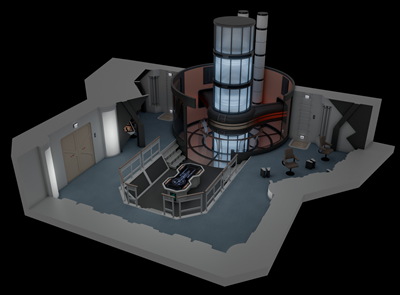 If the Main Bridge is the ship’s brain, then Main Engineering is the Enterprise's heart, serving as the master control center for the Warp and Impulse Propulsion Systems, as well as all other shipboard power distribution. On Century Class starships, this cavernous facility is located on Deck 13, deep within the engineering hull to provide maximum protection during combat operations. While advanced automation allows the compartment to function with only a fraction of the personnel required by earlier vessels, it remains a bustling hub for managing energy production, life support, transporters, and the internal electro-plasma system. In the event of a catastrophic failure of both the Main Bridge and the Combat Information Center, Main Engineering serves as the ultimate backup control center; its workstations can be instantly reconfigured to emulate any primary command functions.
The layout of Main Engineering is centered around the Matter/Antimatter Reaction Assembly, or Warp Core, which spans multiple decks before passing through the main chamber. The primary workspace is a large observation room dominated by a tabletop-style Master Systems Display (MSD), also known as the Master Situation Monitor. This octagonal, dual-operated console provides a comprehensive cutaway of the ship’s "health," highlighting any systems currently experiencing non-nominal conditions and allowing individual engineers to troubleshoot specific tasks without disrupting the larger wall-mounted status displays. These perimeter displays provide real-time schematics of warp coil alignment, impulse performance, and magnetic constriction.
Immediately adjacent to the reaction chamber is a control room that facilitates direct visual monitoring of the visible reaction patterns through a specially reinforced optical window. This office includes repeater versions of all key displays, emergency control stations, and the control chip panels. For safety, the facility is equipped with automatic section isolation doors and a system of containment forcefields designed to seal off the control center in the event of a plasma breach or Warp Core instability. If a breach becomes unavoidable, the entire core assembly can be ejected into space.
The Engineering compartment is a split-level chamber to maximize operational space. The lower portion houses the primary reaction chamber and the horizontal plasma conduits that channel energy to the nacelles while the upper portion maintains workstations for the engineers. This vertical design philosophy, which began with the refitted Constitution II Class, ensures that engineering teams can maintain a clear view of the core and all primary workstations from multiple vantage points throughout the department.
For a detailed tour of the Enterprise's Main Engineering, please visit: U.S.S. Enterprise Engineering Sections.
Categories: Command | Operations