U.S.S. Enterprise Main Bridge
Created by Commodore Wilkan Targaryen on Tue Apr 18th, 2023 @ 12:48am
Main Bridge
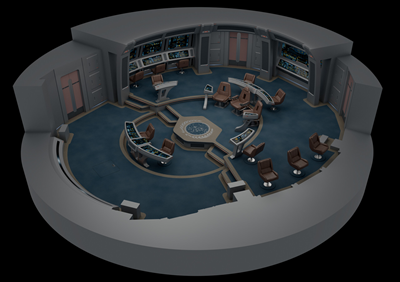 If Main Engineering acts as the heart of the Enterprise, then the Main Bridge is undoubtedly its brain and primary nerve center. Located on Deck 1 at the absolute apex of the primary hull, the Bridge serves as the functional hub for the supervision of all shipboard operations and the coordination of every department aboard the Starship Enterprise. This facility is constantly manned by the vessel's Senior Staff (with the notable exceptions of the Chief Engineer and Chief Medical Officer), providing the Commanding Officer with the ability to execute Starfleet directives and maintain operational authority over both primary and secondary mission functions from a single, secure location.
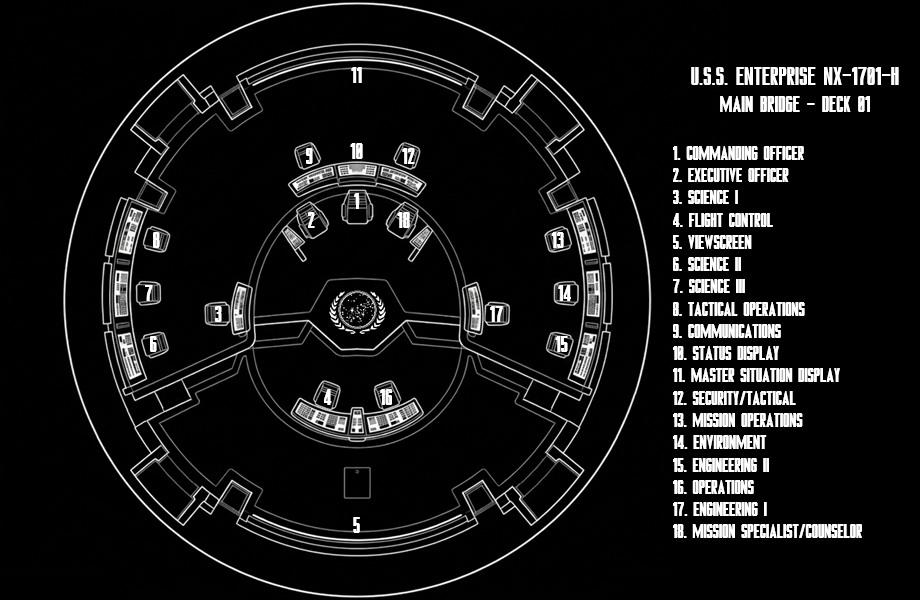
The physical environment of the Bridge reflects an intentional return to the warmer, carpeted aesthetics of the late 24th Century, moving away from the utilitarian and dark motifs often seen in the early 25th Century. While the Bridge was initially compact when the Enterprise launched, it was expanded during a 2439 refit to better suit its revised mission profile. The seating layout emphasizes collaborative command, placing the Captain's Chair at the heart of the room between two other command positions dedicated to the First Officer and a mission specialist. Directly forward of this command area, the Flight Control Officer (Conn) and Operations Manager face a massive forward viewscreen. This primary visual display utilizes an omni-holographic matrix to render information in three dimensions and is flanked by the ship’s dedication plaque.
Workstations lining the perimeter of the Bridge are built with sophisticated tripolymer-coated transparent aluminum surfaces that utilize the Library Computer Access and Retrieval System (LCARS) and Artificial Intelligence Monitoring System (AIMS). These software-defined surfaces are self-configuring and use a sensor matrix to detect tactile input, providing both auditory and haptic feedback to the operator. While the consoles are designed to accept vocal commands, manual input remains the preferred method for high-speed operations to avoid errors in voice discrimination. A unique holo-communicator is integrated into the Federation seal near the Captain’s Chair, allowing for life-like, three-dimensional communication as if both parties were in the same room.
The Bridge is engineered for maximum survivability and is designated as an emergency environmental support shelter. Protected by specialized utility trunks and independent atmospheric modules, the Bridge can maintain Class M conditions for up to 72 hours even if the ship’s primary and reserve life support systems fail entirely. Access to this critical deck is provided by a redundant network of Turbolifts located on the aft starboard and forward port sides, including a dedicated emergency turboshaft that links directly to the Combat Information Center. Security checkpoints at the forward starboard and aft port entryways regulate flow to the rest of Deck 1, providing the command team with rapid access to the Captain's Ready Room and the Executive Conference Room.
Layout
Central Stations - Command Operations
Captain's Chair
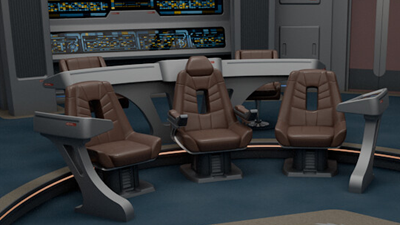
Located in the exact center of the Bridge, the Captain’s Chair serves as the primary command station aboard the Enterprise, providing the Commanding Officer with an unobstructed view of the Main viewscreen. While earlier Starfleet designs often featured an isolated command seat to underscore the responsibility of the role, the modern Bridge layout facilitates a collaborative environment where the Captain sits between two additional command positions typically occupied by the First Officer and a mission specialist. The chair is mounted on a circular pillar with a rectangular footplate anchored directly to the deck to provide stability during combat, yet it retains the ability to swivel so the duty officer can address any member of the Bridge crew at will.The armrests of the chair incorporate miniaturized status displays and software-defined control surfaces that allow the Captain to supervise all primary mission functions. The left-hand interface is nominally configured to manage Flight Control, Operations Priorities, and the ship's library, including the ability to program complex maneuvers such as entering or maintaining a planetary orbit. This side also contains controls for ship-wide hailing signals and the management of auxiliary craft, such as launching shuttles or operating Shuttlebay doors. The right-hand armrest panels primarily govern Communications, Tactical systems, and Viewscreen functions, featuring a dedicated intercom control for intra-ship communication and a chip reader for accessing readouts stored on Isolinear or Positronic chips.
These integrated consoles utilize the Artificial Intelligence Monitoring System (AIMS) and Library Computer Access and Retrieval System (LCARS) to present the most relevant data during encounters with unknown phenomena. The interface is highly versatile; controls are continually monitored and reconfigured by the computer to suit the specific task at hand, meaning a single button may perform different functions depending on the active operational profile. While normally used for monitoring, these armrest controls allow the Captain to execute an emergency override of the spacecraft’s basic operations. Because the Enterprise can be controlled from this chair alone in extreme situations, it remains one of the most secure and vital workstations on the Bridge.
Command Stations
Flanking the central Captain's Chair are two dedicated command stations designed for the Executive Officer and a mission specialist, such as the Ship’s Counselor or a visiting Starfleet dignitary. These stations represent a shift toward a more collaborative command philosophy, providing the vessel's senior leadership with a dedicated area to oversee all shipboard mission activities and provide immediate support to the Commanding Officer during pressurized situations. Unlike the Captain's Chair, which features miniaturized displays integrated into the armrests, these positions consist of larger, free-standing information display terminals.The consoles are mounted on swivel-capable units on the outer side of the seating, allowing the officers to adjust their readouts to suit personal preference or the specific mission at hand. These sophisticated workstations provide comprehensive access to the ship’s databanks, Sensors, and Tactical systems, allowing the staff to monitor Navigation, Communications, and internal operations simultaneously. While the panels are fully compatible with vocal commands, they are primarily operated via manual keypad input to ensure maximum speed and to eliminate the risk of the computer misinterpreting verbal instructions.
During standard cruise mode, the presence of officers at these stations is optional, but Starfleet operating rules generally require at least two command-level personnel to be seated at the central stations during Yellow or Red Alert conditions. This ensures that mission-critical data is constantly analyzed and that the First Officer can immediately update the Captain on the overall status of the Enterprise without the commander needing to divert focus from the Viewscreen.
Communications
The Communications station is situated on the starboard side of the elevated, horseshoe-shaped console behind the command seating, positioned opposite the Security and Tactical station. Serving as the primary gateway for all internal and external data transmissions, this console manages an intricate network of subspace and space-normal frequencies. Dedicated monitor screens provide the officer with a real-time overview of developing situations, ranging from localized ship-to-surface activity to the constant scanning of frequency bands for Starfleet, civilian, or alien traffic.A central component of this station is the Universal Translator interface, which is essential for first-contact scenarios in the Gamma Quadrant. The system matches universal concepts and brainwave patterns to translate alien dialogue into Federation Standard, coordinating with the library computer to evaluate incoming signals and deliver accurate responses. The officer manages the translator’s search routines and updates linguacode databases as the ship encounters new civilizations while also handling the cryptographic security and decryption routines required for secure Starfleet Command transmissions.
Internal coordination is managed through this same hub, overseeing every intership transmission and localized communication link. The station allows the officer to route data processing to the library computer or patch shipwide announcements directly from the command chairs. By integrating subspace relay monitors with the ship’s internal intercoms and personal communicator signals, the station ensures the NX-1701-H remains a cohesive unit, maintaining a vital link between the Bridge and the galaxy at large. Should the primary communications array suffer damage, the station's proximity within the horseshoe allows for seamless coordination with the AIMS-enhanced Tactical and Operations stations to maintain signal integrity.
Security/Tactical
The Security and Tactical workstation, situated on the port side of the elevated, horseshoe-shaped console behind the command seating, serves as the unified hub for the Enterprise’s offensive, defensive, and internal safety operations. Positioned to facilitate swift communication with the Commanding Officer, this station provides comprehensive control over the vessel's primary armaments, including the Type XVIII Phaser Arrays and its torpedo launchers. From this console, the officer monitors real-time weapons inventories, manages the specialized S.H.I.E.L.D.S. grid frequencies, and utilizes the AIMS-integrated Threat Assessment system to identify enemy weaknesses or automate point-defense fire against incoming projectiles.Internally, the station functions as the primary nexus for crew safety through a multi-tiered monitoring system. By leveraging the ship’s internal sensor network, the officer can pinpoint personnel via communicator badges or bio-signatures and automatically detect unidentified intruders. The touch-sensitive LCARS interface allows for the immediate deployment of localized forcefields or the sealing of specific bulkheads across any of the ship's twenty-three decks. Furthermore, this workstation maintains a direct link with the transporter rooms to neutralize localized threats, coordinates security details for diplomatic visitors, and manages the ship’s armory inventories. By consolidating these functions into a single port-side location, the Enterprise ensures that external combat and internal security are managed with seamless coordination, providing a critical layer of redundancy and operational efficiency required for its high-stakes mission in the Gamma Quadrant.
Status Display
The General Status Display, situated between the Security and Tactical workstations on the Bridge's elevated console, serves as a high-density information nexus designed to Bridge the gap between internal defense and external offensive operations. While it primarily functions as a mission-flexible readout during standard cruise mode, its placement makes it the ideal coordination point for integrated combat and security management. In typical scenarios, the display is configured to provide a macro-level overview of the ship's tactical readiness, including real-time shielding integrity across all grids, weapons capacitor charge levels, and the current deployment status of all security details throughout the vessel.As a dedicated backup for both the Security and Tactical stations, this console allows a secondary officer to manage high-volume data tasks that might otherwise overwhelm the primary operators during a Red Alert. The interface can be instantly reconfigured to track localized boarding actions on the internal ship schematic while simultaneously monitoring the targeting solution of the Phasers. By utilizing priority links to the ship's internal sensor network and the tactical subprocessor, the General Status Display can coordinate the launch of specialized probes or the activation of automated point-defense systems, ensuring that no vulnerability is left unmonitored during complex fleet engagements.
Beyond its combat role, the display serves as a vital diagnostic station for the ship's primary defensive hardware. It allows engineers or security personnel to monitor the physical condition of the Phaser Arrays and Torpedo launch tubes without disrupting the primary Tactical Officer's focus on external targets. Through a series of touch-sensitive LCARS panels, the user can conduct rapid recalibrations of the targeting scanners or adjust the frequency of the defensive forcefields to compensate for specific alien weapon types. This strategic placement ensures that the Enterprise maintains a seamless loop of communication between the Bridge's offensive and defensive personnel, providing a critical layer of operational redundancy.
Forward Stations - Flight Operations
Flight Control
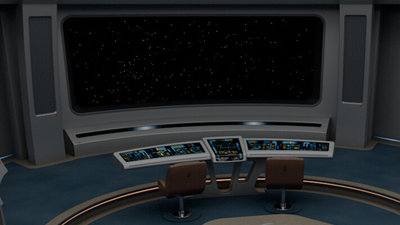
Flight Control, frequently referred to as the Conn, is the primary station responsible for the piloting and navigation of the Enterprise. Located at the front of the Bridge on the starboard side of the Flight Operations terminal, it sits directly in front of the Commanding Officer to ensure a clear line of communication. Although modern interstellar flight is heavily automated, the criticality of the station demands it be constantly manned by a Flight Control Officer who receives instructions directly from the Captain. This officer oversees five major areas of responsibility: navigational course plotting, the supervision of automatic flight operations, position verification, manual flight control, and serving as the Bridge liaison to the Engineering department.From this console, the officer manages the ship’s heading through several input modes, including specific galactic coordinates, relative bearings, or direct intercepts of target vessels. During Impulse spaceflight, the Conn monitors relativistic effects and the status of the Inertial Damping System to ensure maneuvers remain within safety envelopes, though these rules may be bypassed during Alert status. In Warp flight, the officer must monitor Subspace Field Geometry in parallel with Engineering, while the console’s software continually updates Long-Range Sensor data to make automatic course corrections for variations in the interstellar medium. The station also provides direct control over the Reaction Control System (RCS) thrusters, landing struts, and even the launch of probes or message buoys.
The Conn station is designed for maximum redundancy and survivability. It is connected to a dedicated backup flight operations subprocessor and emergency Navigation Sensors, allowing the officer to maintain manual control of the ship even if primary systems fail. In combat situations, the Conn Officer works in close coordination with the Operations and Tactical stations. To ensure the ship remains capable of defense, targeting data and external communications are automatically duplicated at the Conn, providing a secondary point of control should the Tactical station be disabled. During planetary operations, the console receives telemetry on atmospheric conditions, allowing the officer to provide recommendations for Shuttlecraft deployment or orbital maintenance.
Operations
The Operations Station (frequently referred to as Ops) is located at the forward port workstation of the Main Bridge and serves as the central command hub for coordinating the activities of every department aboard the Enterprise. As the vessel's primary resource manager, the Operations Officer is responsible for the sophisticated task of allocating shipboard hardware and power to meet conflicting departmental needs. While the Main Computer handles routine scheduling through high-level Artificial Intelligence, the Ops Manager utilizes specialized decision filters to intervene in complex or unpredictable situations where mission goals might otherwise be jeopardized. By evaluating real-time requests - such as a conflict between a science department’s need for the lateral sensor array and the Bridge’s requirement for a priority scan - the Ops Officer can authorize ship attitude changes or re-prioritize assignments to ensure the most efficient use of the ship's massive yet finite capabilities.Beyond resource management, the Ops station acts as a master diagnostic terminal and a primary link to the ship's computer systems. The console provides a continually updated list of major shipboard activities, from environmental conditions to the monitoring of the Library Computer Access and Retrieval System (LCARS) usage across the vessel. The station is equipped with reconfigurable software-defined surfaces and a dedicated computer subprocessor, allowing it to serve as a backup for other Bridge functions in an emergency. During battle or crisis situations, the Ops Officer works in close coordination with the Tactical and Engineering departments to route power to shields and weapons while simultaneously organizing damage control teams and monitoring sensors.
The scope of the Operations Manager's duties extends to the coordination of external missions and the management of auxiliary craft. Ops is responsible for the logistical preparation of Away Teams, including the notification of personnel, assignment of Transporter Rooms and Chiefs, and the allocation of mission-specific equipment like Phasers and Tricorders. Additionally, all Shuttlecraft launches and approaches require authorization from this station; once a Shuttle clears the bay, the Ops Officer monitors its telemetry as long as it remains within range. From initiating saucer separation sequences to providing the Captain with summarized sensor data on planetary surfaces, the Operations Station ensures that the Enterprise functions as a cohesive, prioritized unit.
Status Display
Positioned centrally between the Flight Control and Operations workstations, the General Status Display serves as the Bridge's primary coordination hub for real-time shipboard logistics and navigation. In its default configuration, this console functions as the ship’s primary Astrogator, a specialized interface dedicated to the high-level synthesis of data from the Enterprise’s navicomputer and stellar cartography databases. By providing a continuous, multi-dimensional readout of the vessel's current trajectory relative to known celestial landmarks and subspace corridors, the Astrogator allows for the precise verification of the ship's position. This facilitates a seamless Bridge between the raw piloting data handled at the Conn and the resource management overseen at the Operations station, ensuring that mission objectives and flight paths remain in perfect alignment.The console's interface is designed to provide at-a-glance situational awareness of the Enterprise's overall "health" and progress. It integrates Long-Range Sensor telemetry with propulsion status readouts, allowing the crew to monitor the impact of environmental factors on the vessel’s course. Because it serves as a Bridge between the two most active command consoles, the General Status Display is often utilized to resolve resource conflicts in real-time. Its location makes it a collegiate workspace where the Flight Control Officer and Operations Manager can confer over complex course corrections or orbital insertion maneuvers without leaving their respective stations.
As a critical node for Bridge security and command authority, the General Status Display is also equipped with a suite of Emergency Override functions. These highly protected controls allow an authorized officer to manually bypass or negate any command entered into the Enterprise’s computer network, regardless of the workstation of origin. This feature acts as the ultimate safeguard against system malfunctions or unauthorized access, providing a centralized point of recovery for the ship's primary computer cores. Linked via dedicated optical data network trunks to the Bridge's own subprocessor, the console ensures that even in the event of a total tactical or engineering failure, the command staff retains the ability to reset system parameters and maintain control over the vessel’s fundamental operations.
Viewscreen
Occupying the majority of the forward bulkhead on Deck One, the Main Viewscreen of the Enterprise serves as the primary visual interface for the Bridge crew, functioning much like a sophisticated "windshield" that allows the Senior Staff to observe the vessel’s flight path and surroundings. While it traditionally displays the output of the forward optical scanners, the screen is a highly versatile, multi-modal display matrix capable of projecting images from any of the ship’s external sensor arrays, regardless of their orientation. This allows the crew to maintain situational awareness in three-dimensional space by shifting the visual focus to the port, starboard, or aft perspectives at a moment's notice.The Viewscreen is constructed using an omni-holographic display matrix, enabling it to render complex data and three-dimensional information with high fidelity. A computerized heads-up display is often projected over the incoming visuals, providing the command team with real-time sensor readings and critical mission data germane to the ship's current status without obstructing the primary view. To facilitate rapid decision-making, this system is linked to a dedicated communications subprocessor, which permits near-instantaneous conversion of nearly any visual communications format, whether internal to the ship or transmitted from a distant alien vessel.
Beyond its role in Navigation and Tactical analysis, the Viewscreen is a central hub for the ship's diplomatic and exploratory functions. It acts as a shared workspace where the Captain, Conn, and Ops officers can simultaneously review Long-Range Sensor data, holographic starcharts, or incoming visual hailing frequencies for ease of contact. Because the Viewscreen is a critical component of Bridge operations, its hardware is integrated directly into the Bridge shell’s armored forward bay, which houses dedicated computer subprocessors to ensure the display remains operational even during significant system failures or high-intensity combat scenarios.
Port Stations - Internal Operations
Engineering I
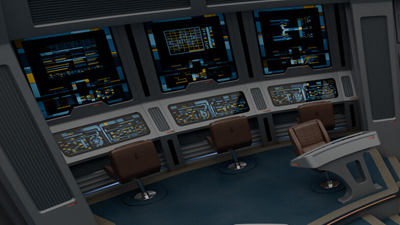
Engineering I, a freestanding console facing inward on the port side of the Bridge, serves as the primary management hub for the Engineering department while the Chief Engineer or a duty officer is on the Bridge. This station provides a comprehensive overview of the ship’s "health," featuring high-resolution displays that replicate the primary readouts and status monitors from Main Engineering. From this location, an engineer can manage any shipboard system, while also conducting real-time diagnostics and recalibrations of core shipboard systems to maintain peak efficiency.Built directly into the Engineering station’s interface are dedicated monitors and controls for the ship's Propulsion Systems. These integrated displays provide a focused, high-level data feed from the Dilithium Crystal Chamber, the Warp Propulsion System, and the Impulse Drive. This configuration allows the engineer to monitor system stability, ensuring that any fluctuations in the Propulsion Plant can be addressed through immediate recalibration. By incorporating these drive functions into the primary engineering terminal, the ship ensures that power distribution and engine performance are managed as a single, cohesive unit.
Beyond routine maintenance, Engineering I provides critical safety overrides for the entire vessel. In the event that Main Engineering on the lower decks becomes inaccessible due to hazardous systems failure or evacuation, this Bridge terminal can initiate an Emergency Warp Core Ejection. This final measure of survival, along with the ability to manually operate the Reaction Control System (RCS) thrusters and reroute power to shields, ensures that the Bridge remains the ultimate point of authority for the ship's most vital and powerful systems.
Engineering II
The Engineering II workstation, situated closest to the Viewscreen on the port side of the Bridge, is a specialized station uniquely configured to monitor and control the Propulsion Systems of the Enterprise. While standard Starfleet Bridge layouts often consolidate these functions into a general engineering terminal, the Enterprise utilizes this dedicated console to manage the unique demands of its experimental Coaxial Warp Propulsion System. This advanced drive requires far more granular oversight than traditional Warp Engines, and the specialized displays at Engineering II allow the duty engineer to monitor the unique spatial folds and high-energy plasma requirements inherent to coaxial travel.As the primary interface for the ship's movement, Engineering II provides a comprehensive data feed from the Dilithium Crystal Chamber and the Warp Core's Reactant Injectors. The station's monitors track the stability of the Subspace Field Geometry in real-time, allowing for the immediate recalibration of the Warp Field to compensate for fluctuations in the interstellar medium. This level of oversight is vital for the Coaxial Drive, which relies on a folding of space-time that is highly sensitive to external gravimetric interference. From this station, an engineer can also manage the Impulse Propulsion Systems and the Reaction Control System (RCS), ensuring that sublight maneuvers are coordinated with the ship's Inertial Damping Field to protect the crew from relativistic effects.
In critical or combat situations, Engineering II can be brought into Full Enable Mode, granting the operator direct manual control over every servo and injector within the Propulsion System. This priority access is supported by dedicated Optical Data Network (ODN) hardlines that link the console directly to the Engine Room, bypassing the Computer Cores if they become unreliable. This redundancy ensures that the Enterprise remains maneuverable even during a total systems failure. Furthermore, this station serves as the final Bridge-level authority for the Propulsion Systems, capable of initiating a Warp Core Ejection or shutdown if the ship's structural integrity is compromised by the experimental stresses of the Coaxial Drive.
Environment
The Environment station, located along the port-side perimeter of the Main Bridge, serves as the primary oversight hub for the vessel's life-support and internal sustainability systems. While these functions are heavily automated and often left unattended during standard operations, the station remains a critical workstation during crisis and alert situations, acting as a "deputy" to the Operations Manager to ensure crew survivability. In its default mode, the console is programmed to monitor a wide array of subsystems including atmospheric composition, temperature regulation, artificial gravity, and inertial damping. It also tracks the status of critical consumables such as water and oxygen, as well as the performance of the recycling and reprocessing systems that provide a continuous supply of food and air.When manned by a specialized Environmental Systems Officer, the station provides granular control over the ship's internal climate. The officer can conduct routine maintenance or perform immediate modifications to the life-support output, such as rerouting power between decks or adjusting localized atmospheric pressures. In extreme tactical or emergency scenarios, the workstation allows for the manual termination of life support in specific sections of the ship or the venting of atmosphere from entire compartments to combat fires or neutralize boarders. These manual overrides are highly protected, requiring authorized command codes to bypass the ship's standard safety protocols.
Beyond mere monitoring, the Environment station is central to the ship’s emergency response infrastructure. The duty officer at this console is authorized to initiate Yellow and Red Alert conditions and is responsible for the execution of survival scenarios, such as coordinating the evacuation of personnel to designated environmental shelter areas. Because the Bridge itself is an emergency shelter, this station is uniquely linked to the protected utility trunks and independent atmospheric modules that can maintain Class M conditions for up to 72 hours. Should any atmospheric or gravity fluctuation occur while the station is unoccupied, the station’s automated programming is designed to instantly alert the Operations Manager to ensure the safety of the crew.
Mission Operations
Located closest to the aft port-side exit, the Mission Operations station is a specialized workstation designed to serve as a direct extension of the Operations Manager's console. Its primary role is to act as a command assistant, relieving the Ops station of lower-priority tasks that require oversight but fall outside the scope of primary mission activities. By managing the assignment of resources and priorities according to established protocols, Mission Ops ensures that the ship's minute-to-minute functions remain efficient, particularly during unforeseen situations that exceed the decision-making parameters of the ship's automated software.A central responsibility of this station is the coordination and monitoring of Away Teams. Mission Ops serves as the primary telemetry hub for parties off the vessel, managing the flow of incoming data. This allows the Bridge crew to maintain a constant link to the landing party’s progress and physiological status. Furthermore, the station oversees the operations of the Enterprise's Shuttlebays and Transporter, notifying the appropriate rooms when a party is departing and ensuring that a Transporter Chief is assigned and equipped with accurate coordinates. Mission Operations also manages the requirements of secondary missions to prevent them from conflicting with the ship's primary objectives. By monitoring secondary sensor usage, the duty officer can resolve low-level resource disputes before they require the intervention of the Operations Manager. During Alert and crisis situations, the station’s role shifts to support the Security Officer, providing critical data on the location and status of Away Teams and evaluating how secondary mission activities might impact the ship's overall defensive posture.
As a critical backup node, the Mission Operations technician often serves as the relief Operations Manager whenever the primary duty officer is away from their station. This ensures a seamless transition of command authority over the ship's internal logistics. Because the station is networked through the Bridge's Optical Data trunks, it maintains a real-time overview of the ship's Communications and Sensor Arrays, ensuring that no department’s request jeopardizes the Enterprise's readiness or mission success.
Rear Stations - Systems Operations
Master Situation Display
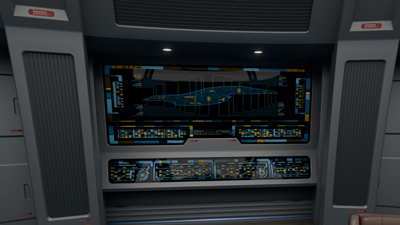
The Master Situation Display (MSD), also known as the Master Systems Monitor, is a primary focal point for shipboard diagnostics and command oversight, situated on the aft bulkhead of the Enterprise Bridge. This large, wall-mounted computer display features a highly detailed, real-time cutaway diagram of the entire vessel, providing a comprehensive overview of the starship's operational status. By integrating data from all primary and secondary systems, the MSD allows the command staff to pinpoint the location of key hardware, evaluate the "health" of the spacecraft, and identify any systems or personnel operating outside of nominal parameters at a single glance.As a Bridge-level replication of the functions found at the Master Systems Table in Main Engineering, the MSD is designed for maximum versatility and troubleshooting capability. It incorporates user control interfaces that allow senior officers or specialized engineers to transition from passive monitoring to active system manipulation. During standard operations, the display serves as a central hub for mission briefings and strategic conferences, enabling the crew to magnify and examine specific ship areas in detail. The station is robust enough to provide complete diagnostic diagrams for any experimental procedures being conducted on board, ensuring that the Bridge remains fully informed of the ship's internal state during complex operations.
In the event of an extreme emergency or the loss of primary Bridge workstations, the Master Situation Display acts as a critical redundancy node. The console can be quickly reconfigured to assume direct control over any system aboard the spacecraft, including limited flight control functions and the routing of power to defensive arrays. Because of its strategic importance, the display is connected to the Bridge’s dedicated subprocessors and can be used to initiate high-level security protocols, such as the autodestruct sequence, provided the appropriate senior officer handprint and voice authorizations are verified. This ensures that the MSD remains an unmatched resource for coordinating damage control and ship survival when the vessel is at risk.
Starboard Stations - External Operations
Science I
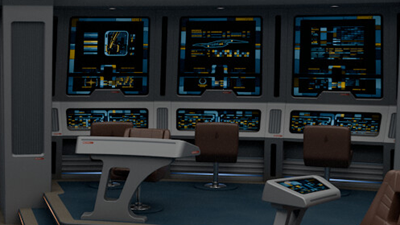
Science I, positioned as a freestanding workstation on the port side of the Bridge, functions as the primary hub for interpreting real-time data from the Enterprise's vast sensor arrays and automated probes. The workstation for the Chief Science Officer, providing an optimized appraisal of the external environment and any encountered anomalies to the Commanding Officer. It is designed to act as a self-contained unit where a vast suite of instruments, including a high-resolution scientific viewer, allows for the visual analysis of complex sensor data and library computer records. Through priority links to the LCARS computer network, the station can gather and coordinate information from various onboard laboratories and secondary missions, ensuring that departmental research does not conflict with primary mission goals.The console is equipped with a sophisticated array of monitors dedicated to fine-tuning the ship’s investigative capabilities. One monitor provides an overall appraisal of sensor activity, while others allow the officer to adjust the interference patterns of specific bandwidths to recalibrate sensors at a moment's notice for command intelligence requirements. This ability to directly override and reconfigure sensor systems is critical during alert status, as it ensures that Tactical or Navigational scans take precedence over secondary departmental observations. Additionally, the station features an Isolinear chip matrix panel that permits the loading of specialized mission profiles, enabling investigators to record and accumulate high-volume data for later study or to manage the complex recovery of automated probes from hazardous environments.
In addition to its role in pure exploration, Science I is a vital node in the Bridge's redundant command structure. During combat or crisis situations, the station can be reconfigured to act as a functional backup for the Conn, Ops, or Tactical stations, allowing for manual flight operations through an X-Y axis pad and providing control over the Reaction Control System (RCS) thrusters. While it is independent of the adjacent Science II and III consoles, the three stations can be interlinked to facilitate cooperative research between personnel or visiting specialists. This flexibility, combined with direct access to the ship’s historical archives and personnel records via the library computer, ensures that the Chief Science Officer can rapidly synthesize and disseminate the information necessary for the ship's survival and the success of its exploratory assignments.
Science II
Science II, situated closest to the Viewscreen on the starboard bulkhead, is a specialized hub dedicated to the high-level functions of Astrometrics, Navigation, and Stellar Cartography. While technically independent, it is designed to interlink with Science I and III for cooperative research or to serve as a secondary command post for personnel attached to complex secondary missions. Its primary purpose is the precise charting of stars, planets, nebulae, and other celestial bodies, utilizing a direct priority connection to the Enterprise's dedicated Astrometrics and Stellar Cartography laboratories. This allows the Chief Science Officer or a mission specialist to manage large-volume observations and complex spatial mapping projects that require closer coordination with the Bridge command staff than can be achieved from the lower-deck labs.A critical aspect of the Science II station is its role in supporting the vessel's flight path. The console works in constant synchronization with Flight Control (Conn) to verify the ship’s position and supervise the performance of the Navigational Sensors. By analyzing long-range data and subspace field geometry, the officer at this station can detect subtle spatial anomalies or gravimetric dangers that might be missed by standard automated flight computers. This cooperative link is essential for plotting optimal courses through uncharted sectors or navigating hazardous regions where minute-to-minute recalibration of the ship’s heading is required to maintain the integrity of the warp field.
The station is equipped with a high-resolution scientific viewer and a suite of calibration monitors that provide a real-time visual representation of sensor data. These interfaces allow for the fine-tuning of sensor bandwidths to isolate specific stellar phenomena, such as the composition of a binary star or the drift of interstellar dust. During alert conditions, Science II can override secondary departmental projects to focus entirely on command intelligence requirements, providing the Captain with a detailed appraisal of external threats or items of interest. Its flexible architecture also permits the loading of specialized Isolinear Chips, ensuring that investigators have the localized processing power necessary to accumulate and analyze the vast amounts of data generated during deep-space exploration.
Science III
Science III, positioned as the central workstation among the starboard consoles, is the primary hub for the Life Sciences division, serving as a critical Bridge liaison for the Enterprise's medical and biological staff. While the station is often utilized by the Chief Medical Officer or a specialized biologist, it remains an independent and highly adaptable console that can be interlinked with Science I and II for cooperative research. Its core function is the investigation of any lifeforms encountered during the ship’s mission, encompassing a broad spectrum of disciplines including microbiology, physiology, biochemistry, botany, and zoology. Because of the station's specialized focus, it maintains a priority connection to Starfleet Medical and is directly networked with the medical computers in Sickbay, ensuring a seamless flow of data between the Bridge and clinical environments.The console is equipped with a high-resolution scientific viewer and a suite of Sensors calibrated specifically for biological detection and analysis. Unlike general science stations, Science III is configured to monitor bio-signatures, brainwave patterns, and cellular structures in real-time. This capability is essential during first-contact scenarios or away team missions, where the station coordinates with the Communications and Mission Ops consoles to evaluate the physiological impact of alien environments on the crew. The station also facilitates the analysis of planetary ecosystems, allowing the officer to identify potential pathogens or beneficial biological compounds before the ship enters orbit or deploys personnel.
Beyond external exploration, Science III serves a vital internal role by monitoring the overall health and well-being of the Enterprise's crew. Through its link to the ship’s internal sensor network and communicator badge telemetry, the station can provide a real-time appraisal of the crew’s vital signs during a crisis, automatically alerting the Commanding Officer to injuries or the presence of non-human biological signatures within the ship. In the event of an outbreak or biochemical threat, the Science III officer can rapidly recalibrate the environmental sensors to track the spread of contaminants and coordinate with the Engineering and Environment stations to implement localized containment protocols. This integration ensures that the safety of the ship's biological complement is managed with the same precision as its mechanical systems.
Tactical Operations
The Tactical Operations console, situated closest to the Starboard aft Turbolift on the Main Bridge, serves as a specialized support hub for the Enterprise’s defensive and offensive arrays. While the primary Security and Tactical workstation handles immediate combat maneuvers, this dedicated station provides deep-system management and critical redundancy. It is engineered to monitor the ship’s weapons inventory in real-time, providing detailed telemetry on the recharge status of the Type XVIII Phaser Arrays and the live countdowns for the vessel’s torpedo launchers.From this position, a Tactical Officer can manage the deployment of various sensor probes and calibrate specialized energy transfer beams for non-combat applications. During high-intensity engagements, the console’s primary utility lies in its integration with the S.H.I.E.L.D.S. grid. The operator is responsible for the complex remodulation of shield frequencies and the strategic rerouting of power from secondary systems to bolster the ship’s regenerative external plating. The station also utilizes the AIMS-enhanced Threat Assessment system to analyze the structural weaknesses of opposing vessels, feeding this data directly to the command staff to refine combat tactics.
Crucially, the Tactical Operations console serves as the fail-safe backup for the primary Security and Tactical workstation. Should the port-side horseshoe console be disabled, this starboard wall station can be instantly reconfigured to assume full guidance and firing control of the ship's armaments. By networking all targeting data to the Conn and Ops positions, it ensures that the Enterprise maintains full defensive capabilities even under extreme localized damage.
Disclaimer
The Enterprise Bridge began life as the USS Emmett Till - Deck 01: Main Bridge designed by Tadeo D'Oria. No infringement intended.Categories: Operations | Science | Tactical | Personnel | Command