Gamma Quadrant Phenomenon
Created by Commodore Wilkan Targaryen on Sat May 30th, 2026 @ 12:46pm
Gamma Quadrant Phenomenon
Bajoran Wormhole
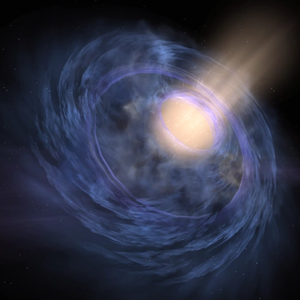 The Bajoran Wormhole is a unique and singular phenomenon in the Milky Way Galaxy, serving as the only known stable wormhole in existence. Located near the border of the Idran and Rakhar sectors, it acts as a miraculous bridge connecting the Alpha and Gamma Quadrants. Before its discovery, the wormhole was considered a mere myth by the galactic community, yet for the Bajoran people, it had been a cornerstone of their culture for ten thousand years. Known to them as the Celestial Temple, it is revered as the dwelling place of the Prophets, powerful extra-dimensional beings whom the Bajorans worship as gods. The wormhole’s discovery in 2369 by Commander Benjamin Sisko and Lieutenant Jadzia Dax fundamentally altered the political and strategic landscape of the galaxy, turning the backwater Bajor system into one of the most critical crossroads in known space.
Astronomically, the wormhole is an artificial construct that creates a nearly instantaneous shortcut between points that would otherwise be separated by approximately 70,000 light-years. In the Alpha Quadrant, its terminus is located within the Denorios Belt of the Bajoran system, while in the Gamma Quadrant, it emerges in deep space, less than five light-years from the Idran system. Because it is stable, the passage lacks the hazardous resonance waves found in naturally occurring wormholes, although it is characterized by elevated neutrino emissions and self-sustaining verteron particles. To manage this vital gateway, the Federation relocated the space station Terok Nor — renamed Deep Space 9 — to the Alpha Quadrant entrance. In the early 25th Century Deep Space 47 - the former Empok Nor - was established to monitor and control the Gamma Quadrant terminus on behalf of the Federation.
Throughout the late 24th Century, the wormhole was the center of intense geopolitical conflict. Its opening allowed for exploration and trade but also brought the Alpha Quadrant into direct, violent contact with the Dominion. The wormhole served as the primary theater for the Dominion War, with both sides frequently attempting to secure, collapse, or blockade it to prevent reinforcements from reaching the other side. It has survived sabotage attempts, trilithium explosions, and even the wrath of the Pah-wraiths, who once caused it to collapse entirely. Following the conclusion of the war, the wormhole remained a symbol of the fragile peace between the two quadrants until the Attack on Mars in 2385.
Following the attack, the Federation became insular, leading to exploratory missions and travel through the passage to drop precipitously, rendering transit rare for decades. This period of isolationism finally concluded in 2439, when the Dominion and the Federation signed a landmark exploratory treaty, effectively reopening the gateway to systematic cooperation and scientific inquiry. It stands today not just as an engineering marvel of an alien intelligence, but as a monument to the endurance of Bajoran faith and the complex interplay between science, politics, and the divine in a rapidly expanding galactic community.
Chamra Vortex
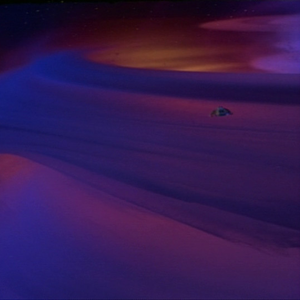 The Chamra Vortex is a dense, volatile interstellar gas cloud classified as a Mutara Class nebula, situated within the Rakhari Sector of the Gamma Quadrant. Located only a few light-years from the homeworld of the Rakhari species, the nebula is notorious for its treacherous navigational conditions. Its interior is characterized by a high-density field containing millions of drifting asteroids and erratic pockets of highly flammable toh-maire gas. Because of these hazardous environmental factors, the region remained largely uncharted for much of the 24th century, frequently serving as a sanctuary for smugglers, fugitives, and criminal elements seeking to avoid detection by regional authorities. The combination of dense gaseous obscuration and constant gravitational flux from the asteroid field makes the vortex an ideal, albeit dangerous, location for clandestine operations.
Historically, the vortex gained notoriety during the 2360s when the criminal Croden utilized a hidden asteroid within the nebula to conceal his daughter, Yareth, in a stasis pod, effectively keeping her beyond the reach of the Rakhari government. In 2369, the nebula became the site of a high-stakes encounter involving Constable Odo, who was lured into the vortex under the false pretense of investigating a non-existent Changeling colony. During this mission, the volatile nature of the nebula was exploited for tactical advantage; the flammable pockets of toh-maire gas were ignited by incoming weapons fire from a pursuing Miradorn vessel, resulting in the total destruction of the attacker’s ship. This event highlighted the lethal potential of the vortex, proving that its environmental instability could be utilized by skilled pilots as a potent defensive tool.
Following the geopolitical shifts that reshaped the Gamma Quadrant in the late 24th and early 25th centuries, the Rakhari Sector is no longer under Dominion control. With the Dominion’s influence retracted from this region, the sector has transitioned into a more autonomous zone. This political evolution has fostered a renewed era of exploration. In 2439, the Enterprise was assigned to conduct a comprehensive survey of the area, during which Federation explorers successfully charted the vortex and discovered a series of previously unknown, rogue worlds drifting within the nebula’s periphery. These findings have reignited scientific interest in the Chamra Vortex, transforming it from a mere smuggling hideout into a site of ongoing discovery, where the interplay of gas, dust, and rogue planets continues to offer new insights into the formation and evolution of star systems in the deep Gamma Quadrant.
Jenkata Nebula
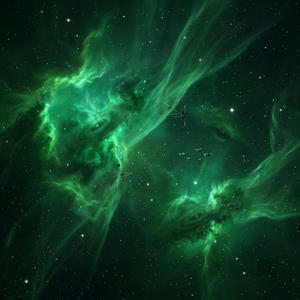 The Jenkata Nebula is a vast, visually striking region of ionized gas and stellar dust located within the Gamma Quadrant, specifically positioned along the fringes of what was once a highly contested border region. Characterized by its brilliant, emerald-hued luminosity caused by high concentrations of rare noble gases, the nebula acts as a natural light-show against the backdrop of the deep void. Unlike the volatile, asteroid-laden environments of other neighboring nebulae, the Jenkata region is remarkably calm, featuring sweeping, translucent gas curtains that extend for thousands of light-years. This relative stability, coupled with the nebula’s unique chemical composition, has made it a site of interest for long-range research vessels and spectroscopic surveys that seek to understand the stellar nursery processes occurring within its dense, glowing cores.
Historically, the Jenkata Nebula was sparsely documented during the era of Dominion dominance, primarily because it offered little in the way of strategic resources or tactical concealment. Its wide, open lanes are difficult to navigate covertly, and the lack of substantial solid matter — such as asteroids or planetoids — meant that there were no natural shelters for clandestine operations or hidden outposts. Consequently, the nebula remained largely undisturbed by the major powers of the quadrant throughout the Dominion War and the subsequent years of upheaval. It served as a peaceful, neutral transit zone that allowed for safe passage for civilian and scientific traffic, far removed from the heavily fortified sectors that marked the core of the Dominion’s domain.
In the years following the withdrawal of Dominion forces from the surrounding sectors, the Jenkata Nebula has seen a surge in civilian and academic activity. Its calm nature has made it an ideal location for the construction of deep-space observation platforms, which utilize the nebula’s unique gas density to monitor subspace activity across the quadrant. In 2439, as part of the broader exploratory initiatives established by the Federation-Dominion treaty, the nebula became a focal point for joint scientific cooperation. These missions have led to the discovery of proto-planetary discs forming deep within the nebula’s emerald clouds, providing scientists with an unprecedented look at how star systems coalesce. Today, the Jenkata Nebula serves as a bridge of cooperation rather than a barrier of conflict, standing as a tranquil beacon in a quadrant that is finally beginning to move past its history of iron-fisted control and military confrontation.
Obatta Cluster
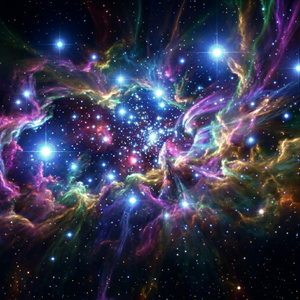 The Obatta Cluster is a dense, high-activity stellar nursery situated within the Gamma Quadrant, renowned among long-range surveyors for its chaotic, brilliant beauty. Unlike the vast, expansive nebulae that often define the sector's geography, the Obatta Cluster is characterized by a tightly packed group of young, blue-giant stars surrounded by glowing, multi-colored ionized dust. These stars emit intense levels of ultraviolet radiation, which illuminates the surrounding clouds of hydrogen and helium, creating a visual display of shifting neon blues and deep, radiant purples. The gravitational environment within the cluster is exceptionally complex; the proximity of the stars results in constant tidal interactions and high-velocity stellar winds, making navigation through the heart of the cluster a task requiring precise sensor calibration and advanced navigational shields.
In the historical context of the 24th century, the Obatta Cluster remained largely ignored by the Dominion, which viewed the region’s extreme radiation levels and gravitational instability as too burdensome for conventional logistics. Because the cluster lacked stable orbital paths for mining platforms or military outposts, it was bypassed in favor of more resource-rich systems. This neglect allowed the cluster to remain a wilderness of sorts, occasionally utilized by independent scouts and fringe traders who took advantage of the intense background radiation to mask their warp signatures from Dominion long-range sensor arrays. It served as a functional, if dangerous, "blind spot" in the Gamma Quadrant’s otherwise iron-tight surveillance grid, providing a fleeting moment of freedom for those who knew how to navigate its turbulent gravity wells.
Following the geopolitical shifts that moved the sector away from Dominion oversight, the Obatta Cluster has evolved into a primary site for high-energy astrophysics. The cluster’s unique conditions — specifically the rapid birth and interaction of its massive stars — offer a perfect laboratory for studying stellar evolution in real-time. In 2439, as part of the post-treaty scientific expansion, joint research teams from the Federation and their Gamma Quadrant partners established a series of automated sensor buoys orbiting the cluster's perimeter. These buoys monitor the interactions of the blue-giant stars, documenting the formation of new, exotic planetary bodies that seem to defy standard accretion models. Today, the Obatta Cluster stands as a vibrant center of scientific inquiry, proving that even the most chaotic and inhospitable corners of the galaxy can be transformed into beacons of knowledge when the drive for empire is replaced by a shared commitment to discovery.
Categories: No categories found