Gamma Quadrant Species (S-Z)
Created by Commodore Wilkan Targaryen on Fri May 29th, 2026 @ 1:52am
Gamma Quadrant Species (S-Z)
Saltah'na
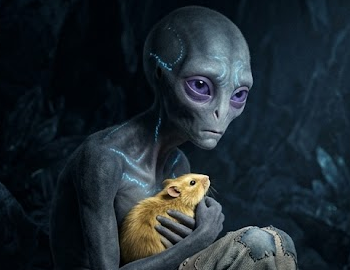 The Saltah’na were an ancient humanoid species native to the Gamma Quadrant, renowned for their dark, heat-absorbing skin, bioluminescent markings, and highly adaptable physiology. Physically, they were slender beings with elongated fingers, respiratory slits, and large violet eyes capable of surviving in extreme, low-light, or thermally unstable environments. Historically, their society achieved extraordinary sophistication in neurology, containment, and psychic engineering, developing the ability to preserve thought-patterns, matrices, and historical records within specialized energy spheres and biological hosts; however, this scientific advancement gave rise to a dark cultural practice: rather than utilizing conventional incarceration, the Saltah’na engineered living hosts to act as biological prisons for their most dangerous criminals. Paired with symbiotic creatures known as A’shura (which served as external biological regulators and stabilizing thermal seals) these hosts were forced to carry dozens of violent minds locked inside their own neural architecture, reflecting a civilization that viewed justice and extreme personal sacrifice as inextricably linked.
Before their complete demise, the Saltah'na were destroyed by a catastrophic, species-wide power struggle that ultimately drove them to extinction prior to the late 24th century. Centuries earlier, during the height of their empire, a prison transport carrying the host Xurbam suffered a catastrophic failure and crashed on a Class M rogue planet inside the Chamra Vortex, leaving him stranded in a state of reduced metabolic "simmering" for nearly nine hundred years. In 2369, the IKS Toh'Kaht discovered the ruined remains of the Saltah’na civilization, accidentally unearthing the psychic energy spheres that preserved the telepathic imprint of the ancient civil war. The residual influence infectiously spread through the Klingon crew, driving them to turn on one another and destroying the ship upon its return to the Alpha Quadrant. This lingering psychic echo subsequently infected Deep Space 9, briefly plunging station leadership into a parabolic re-enactment of the Saltah'na conflict — manifesting in Captain Sisko's obsessive construction of a Saltah'na clock — before the crew managed to break free of the influence.
The true, physical danger of the Saltah’na legacy resurfaced in 2377 when the crew of the USS Enterprise rescued Xurbam from his long isolation, inadvertently weakening his A’shura containment seal. When Xurbam’s mind fractured, he went on a violent rampage through the ship, absorbing the memories and skills of every crew member he killed until a Lexorin-based harmonic treatment restored his original consciousness long enough for him to voluntarily terminate his life to contain the collective. Today, the Saltah’na exist only as a cautionary mystery, remembered not as enduring conquerors, but as a civilization whose brilliance was eclipsed by their self-destructive hubris. Their dead homeworld remains a hazardous archaeological graveyard, dangerous to explorers due to ancient automated defense grids and lingering telepathic remnants embedded within the planet's ruins — a stark monument to a people who mastered the complex architecture of the mind, yet ultimately brought about their own total annihilation.
Sen Ennis
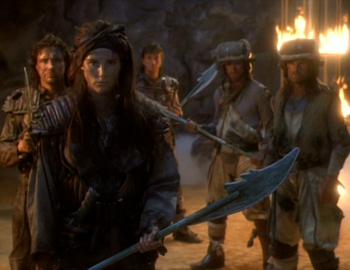 The Ennis and the Nol-Ennis were once two distinct factions of a humanoid species native to the planet Tevlin-De, locked in a brutal, multi-generational war that had long ago rendered the original cause of their conflict forgotten. Viewed by their homeworld’s government as a threat to societal stability and a source of unnecessary bloodshed, the two factions were forcibly exiled to a Class M moon in the Gamma Quadrant. As a final, torturous deterrent to other warring factions, the Tevlin-De leadership deployed advanced bio-mechanical microcellular technology — a network of nanites permeating the moon’s biosphere and atmosphere — that effectively rendered death impossible. Anyone who perished on the moon was almost immediately resurrected, trapped in an endless cycle of warfare with no hope of victory or respite. This resurrection was inextricably linked to the moon’s environment; because the nanites only functioned within that specific atmosphere, any individual who had been brought back to life would immediately die permanently if they attempted to leave the satellite.
For centuries, the two factions remained isolated from the rest of the galaxy, their savagery sustained by an artificial orbital network that masked sensor readings and deterred outside interference. The situation changed in 2369 when the Bajoran Kai, Opaka Sulan, died on the moon’s surface and was subsequently reanimated by the nanite field. Stranded and unable to return to Bajor, Opaka dedicated herself to mediation, serving as a negotiator between the Ennis, led by Golin Shel-la, and the Nol-Ennis, led by Zlangco. While early attempts by Starfleet to bring the two sides to peace — most notably in 2369 — were met with total failure due to the deep-seated hatred and distrust ingrained in both groups, Opaka’s long-term presence eventually began to bear fruit. In 2372, her persistent efforts finally brokered a lasting cease-fire, which eventually led to the two factions uniting under the name Sen Ennis.
The moon itself became a point of significant interest for the Dominion. Although the Founders generally avoided the site, fearing that the nanite technology might hold secrets that could jeopardize their control over the Jem’Hadar or otherwise threaten their dominance, they maintained a cautious watch over the system. A Founder once infiltrated the local populace in an attempt to restart the conflict, only to be deterred by Opaka’s uncanny ability to discern their true nature — an anomaly the Founders attributed to the mysterious technology of the world’s creators. Following the end of the conflict, the Sen Ennis moved beyond their history of eternal war, successfully shedding the cycle of violence that had defined their existence for centuries, though they remain bound to the moon by the very technology that once turned their lives into a perpetual Hell.
Skrreean
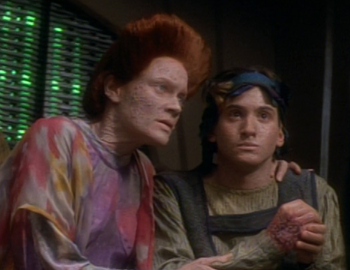 The Skrreeans, or Skrreea, are a humanoid species originating from the Gamma Quadrant planet Skrree, historically recognized for their idyllic, pastoral society and matriarchal social structure. Once a peaceful people who lived off the land with little ambition for interstellar travel, their world was transformed into a site of centuries-long trauma. Physically, they resemble humans but are distinguished by rough, abrasive skin. This unique texture causes them to shed flakes routinely, a condition that has occasionally led other species to treat them with unearned disdain. Skrreean women are typically taller and larger than their male counterparts, serving as primary leaders, as the culture holds that males are too emotional to manage positions of responsibility. It is not uncommon for Skrreean women to have multiple husbands, each leading their own polyfamily units.
For eight centuries, the Skrreeans endured the brutal oppression of the T-Rogorans, who forced the population into indentured servitude. Their arduous history left them a resilient but peaceful people, ill-equipped to defend themselves. In 2370, the Dominion’s conquest of the T-Rogorans provided an unexpected opportunity for liberation. As the Dominion fleet closed in, the T-Rogoran invaders abandoned their posts, allowing the Skrreeans to commandeer discarded freighters and launch a massive exodus. Guided by their polyfamily matrons and a long-held prophecy of salvation on a mythical paradise world called Kentanna, millions of refugees scattered across the Gamma Quadrant.
A significant group of three million refugees, led by Haneek, discovered the Bajoran Wormhole. Upon arriving at Deep Space 9, Haneek identified the anomaly as the "Eye of the Universe" and became convinced that Bajor was Kentanna. They petitioned the Bajoran government to settle there, offering their agricultural expertise to reclaim land damaged by the Cardassians; however, the Bajoran government denied the request. Following a tragic incident where Haneek’s son, Tumak, attempted to force a landing on Bajor and was killed, Haneek accepted a Federation offer to relocate her people to Draylon II.
Meanwhile, their homeworld, Skrreea, has suffered a grim fate. The planet, once fertile, was reduced to a landscape of glass and slag by Jem’Hadar orbital artillery. The few Skrreeans unable to escape were subjected to Dominion control. In a cruel twist, Vorta generals allowed the remaining Skrreeans to execute their former T-Rogoran captors before forcing the survivors into harsh labor as miners. Today, while refugees on Draylon II have resumed their agricultural lifestyle, the native population on Skrreea endures a life of extraction under conditions nearly as grueling as their original enslavement.
Stakoron
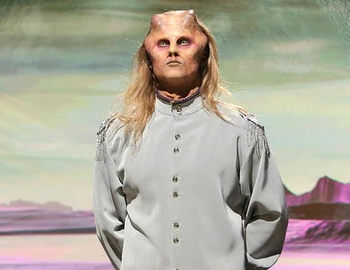 The Stakoron are a resourceful and industrially significant humanoid species native to the planet Stakoron II, located deep within the Dominion-controlled sectors of the Gamma Quadrant. Historically, the Stakoron have distinguished themselves as key suppliers of rare minerals, most notably the highly sought-after mizainite ore. Their world has long been a focal point for interstellar commerce, drawing the attention of mercantile powers from across the quadrant, including the Ferengi Alliance. In 2369, the pursuit of lucrative mining contracts brought the Stakoron into the periphery of Federation awareness when the Grand Nagus Zek sought to secure a supply of mizainite, a move that highlighted the Stakoron’s strategic importance in the regional economy.
Little is known about the specific physiological or social nuances of the Stakoron, though their reputation among other species suggests they are formidable negotiators who command respect and perhaps even fear. Ferengi accounts suggest an imposing physical presence, often using the species as a benchmark for intimidating business partners. Beyond their industrial output, the Stakoron have demonstrated a degree of cultural diversity and integration within the broader Gamma Quadrant. By 2377, Stakoron individuals were active as professionals in other regions, with notable figures such as Juno Mellias serving as an archaeologist and gemologist for the Even Odds. This indicates that despite their planet’s immersion within Dominion space, individual Stakoron possess the agency to pursue specialized careers that extend well beyond the confines of their homeworld.
Under the Dominion’s long-standing administration of their territory, the Stakoron have adapted their mining and export infrastructure to meet the requirements of their masters. While they are effectively subjects of the Founders, the Stakoron have maintained their role as essential providers of raw materials, ensuring their continued relevance within the Dominion’s internal supply lines. While they remain an enigmatic people to the Federation, the Stakoron continue to influence galactic trade, their legacy built upon the foundational wealth of their mineral-rich world and their ability to navigate the complex geopolitical landscape imposed by the Dominion.
T-Rogoran
 The T-Rogorans serve as a stark reminder of the adage that there is always a bigger fish, having once operated as a regional powerhouse for centuries while the Dominion focused its attention elsewhere. Native to T-Rogoran Prime in a unique trinary star system, this species reached warp capability around 1570. Physically, they vaguely resemble Earth crustaceans, though they are entirely terrestrial and fully adapted to Class M environments. Historically, T-Rogoran society was defined by a rigid warrior class that exclusively targeted less-developed civilizations to build an exploitative support base. For 800 years, they traveled from system to system, extracting tribute and labor to fund lives of leisure, all while reproducing fiercely to maintain their dominance.
Their most notorious campaign involved the subjugation of the Skrreeans, a race of humanoid farmers. For eight centuries, the T-Rogorans ruled these subjects with extreme cruelty, executing leaders and forcing the population into indentured servitude; however, this era of unchecked conquest ended abruptly when the Dominion finally turned its gaze toward their sector. The ensuing conflict was prolonged only by the T-Rogoran’s high population and rapid reproduction rates. It took the Jem’Hadar fleet several years to methodically track down and destroy the entire T-Rogoran armada.
The final collapse occurred in the 2360s. By the time the Dominion conquest was nearing completion, the T-Rogoran hegemony had already fractured; many of their previously oppressed subjects were in open rebellion. These groups commandeered their former overlords' vessels to flee the encroaching Dominion, while a desperate few T-Rogorans even joined the Dominion’s military, reasoning that any authority was preferable to the inevitable wrath of the Jem'Hadar.
In the post-conquest era, the T-Rogorans experienced a precipitous decline. The surviving members are now mere subjects of the Dominion, frequently relegated to labor camps. In an ironic twist of fate, these facilities are often overseen by members of the very races the T-Rogorans previously enslaved. This once-proud warrior race is currently on the verge of extinction; experts estimate that if they fail to recover their numbers and social standing soon, they may disappear entirely within a single generation. While the species faces oblivion, T-Rogoran artifacts have become highly sought-after in the postwar years, serving as rare, grim relics of a fallen empire that once believed its power was absolute.
Talu
 The Talu are a physically imposing, bipedal species defined by thick, shaggy coats of white fur and a unique facial structure evolved for a Class P world. Standing significantly taller than humans, their insulating bodies are layered with dense muscle and fat to withstand sub-zero temperatures. Their most striking feature is a set of four distinct eyes. The larger pair is specialized for infrared vision, allowing them to navigate the pitch-black tunnels of their subterranean cities and deep-crust mines. The smaller, secondary pair is shielded by natural telescopic filters, specifically adapted to handle the blinding, high-intensity glare of the Talu sun reflecting off the planetary ice.
Socially, the Talu value quiet industry and communal harmony over individual conquest. Their society is organized into tight-knit clans that inhabit sprawling underground warrens, where geothermal heat provides a stable environment away from the "Clear-Snow" surface winds. Communication is a complex mix of deep, resonant vocalizations and subtle shifts in posture. Despite their formidable size and sharp, clawed hands evolved for ice-climbing, they are not naturally aggressive; however, their physical strength is immense, and they defend their tunnel networks with a fierce, coordinated efficiency that relies on their superior multi-spectral vision.
The Talu’s primary interaction with the wider galaxy is defined by their mastery of mineralogy. As the sole harvesters of the Talu Pearl, they utilize sophisticated, non-invasive mining techniques that preserve the structural integrity of the glaciers above their homes. This resource has made them a vital, if reclusive, economic power. While they do not seek conflict, their long-standing trade agreement to supply the Dominion with pearls has made them a fixture in Gamma Quadrant logistics, a relationship that provides the high-yield energy cells and advanced atmospheric scrubbers needed to maintain their massive subterranean population.
During his recent first contact mission, the first contact team noted that the Talu possess a profound sense of territorial sovereignty. Wary of Federation exploration, they are hesitant to disrupt their established commerce. For the Talu, pearls are a tool of diplomacy that ensures their frozen world remains undisturbed by the warring factions of the surface dwellers.
Teplan
 The Teplan civilization, once a formidable power in the Gamma Quadrant capable of challenging the Dominion, serves as a harrowing cautionary tale for any race contemplating rebellion. In the mid-22nd Century, the Teplans successfully organized an alliance of neighboring systems, threatening to halt Dominion expansion. Wishing to dismantle this threat without resorting to immediate, outright genocide — a tactic the Founders feared would only galvanize other Gamma Quadrant species — the Dominion ordered the Vorta and Drai to develop a more subtle, yet devastating tool of subjugation. The result was the Blight, a biological weapon that effectively killed an empire.
The Blight is a unique, insidious infection that permeated the entire Teplan genome, spreading from their outer colonies to the homeworld. The disease is notoriously brutal, as its progression is drastically accelerated by exposure to electromagnetic radiation. In the aftermath of their defeat, the Teplans were forced to deactivate the majority of their advanced technology to survive, causing a once-glorious interstellar society to regress into a crumbling, medieval existence. Victims of the disease display grayish marks along their arteries, which eventually erupt into a brilliant red rash as they approach the "Quickening"—a final, agonizing stage that leads to certain death.
The human cost has been immense. Within ten years of the Blight’s deployment, most Teplan colonies were wiped out. Survivors on the homeworld face an uncertain future; there is no standardized lifespan, with some individuals surviving into their fifties while others perish before reaching adulthood. Following medical intervention by the Federation in 2372, Doctor Julian Bashir successfully developed a vaccine that prevents the infection in unborn children by inoculating pregnant mothers. However, this breakthrough does not cure those already afflicted. The Teplans now face the monumental, generational task of rebuilding their shattered economy and redeveloping their lost scientific knowledge from scratch.
Tosk
 The Tosk are a reptilian humanoid species from the Gamma Quadrant whose name translates to "The Hunted." Characterized by an alligator-like appearance with greenish scales, slit eyes, and fanged teeth, they are a biological curiosity engineered by the Drai to serve as the ultimate prey in their sacred ritual. While they hold no official place in the Dominion’s "Way of Things," they remain a subject race of the Drai, who believe that a Hunter’s stature is directly derived from the cunning of their quarry. Most Tosk are instilled with an inbred desire to perform the Hunt, finding a sense of grim satisfaction in their constant adaptation and successful escapes.
Biologically, the Tosk are masterpieces of evasion. They require only 17 minutes of sleep per day and do not need to consume food or drink to survive. Their hardy physiology makes them exceptionally difficult to detect on sensors, even when they are not utilizing their "shroud" — a genetic ability to become invisible to the naked eye and scanning equipment. Because of these traits, the Founders utilized the Tosk genome as the foundational template when they commissioned the Drai to create the Jem’Hadar. If they were not intended solely for evasion, their superior strength and resilience would easily make them formidable warriors.
Culturally, the Tosk possess no formal group identity; as soon as they reach maturity, they are set loose and the Hunt begins. They operate under a strict code of honor and an Oath of Silence, never discussing the details of the chase. Within Dominion space, crossing paths with a Tosk is considered a sign of good luck, as it often heralds a fortuitous encounter with the wealthy, powerful Drai Hunters who follow close behind. Due to widespread tales of brutal Hunter vengeance against those who interfere, the sanctity of the Hunt is absolute.
In 2369, first contact occurred at Deep Space 9, marking the first Gamma Quadrant visitor to the Alpha Quadrant. Later, the crew of the Enterprise encountered a next-generation specimen known as Tosk 2.0. This elite creature, engineered to be even more elusive, served as the Chief Medical Officer for Odo's expedition. Following the mission, the creature stowed away aboard the Enterprise. Rather than be returned to the Drai in disgrace, Tosk 2.0 staged a daring escape. Executing a final, devastating tactical strategy, the creature bypassed defense grids and detonated a stolen shuttlecraft in a high-warp strike directly on the Hunter homeworld of Drai V.
Varalan
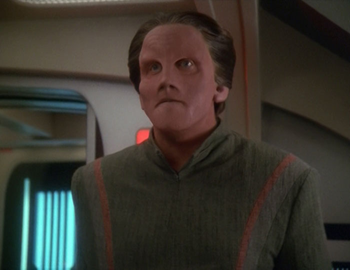 The Varalans are a stoic, humanoid civilization native to the planet Varala, located deep within the territory of the Gamma Quadrant. Though they once maintained a quiet existence on the periphery of galactic affairs, their system is now firmly under the direct control of the Dominion. Despite this subjugation, the Varalans have preserved a culture defined by a deep sense of permanence and tradition, which is reflected in their language; notably, their word for "changeable" is "Laas," a term that became significant during a unique historical intersection between their people and the broader galaxy.
In the 22nd century, the Varalans became the unexpected hosts to Laas, one of the Hundred Changelings who had been sent into the galaxy by the Founders. During his time on Varala, Laas was deeply integrated into their society, even assuming a humanoid form that mimicked the physical appearance of the Varalan people. He lived among them for years, eventually entering into a long-term relationship with a Varalan woman. This period serves as a foundational element of Varalan history, as their interaction with a shapeshifter provided them with a unique perspective on the nature of identity and biological limitation, particularly after the couple discovered they could not have children. While the relationship eventually ended, the cultural memory of Laas remained a point of intrigue within Varalan society.
Beyond their encounter with Laas, the Varalans have cultivated a rigid, structured existence that likely stems from their long history of relative solitude, which now operates under the watchful eye of Dominion administrators. They are a species that prizes consistency and stability, which contrasts sharply with the fluid nature of the Changelings who once walked among them. Even as the Dominion solidified its grip on their system, Laas maintained a connection to the Varalans; when returning from the Great Link in 2376, he frequently reverted to his Varalan guise as a way of grounding himself. This behavior suggests that, despite the loss of their political autonomy to the Founders, the Varalans possess a quiet, enduring presence that left an indelible mark on those who lived alongside them, ensuring their unique cultural identity persists even within the broader, enforced order of the Dominion.
Vorta
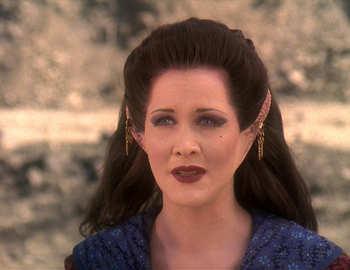 The Vorta are a humanoid species from the Gamma Quadrant, native to Kurill Prime, who serve as the Dominion’s primary administrators, diplomats, scientists, and field commanders. They are the public face of the empire, often acting as demagogues, spies, or clergymen who preach the gospel of the Founders. According to their legends, they were originally timid, tree-dwelling primates who earned their elevation by saving a fleeing Changeling from a hostile mob. In gratitude, the Founders structurally uplifted the species, engineering them into powerful, loyal servants. To draw attention away from the Founders themselves, many species are led to believe that the Vorta are the Founders, a ruse that successfully masks the true nature of Dominion leadership.
Physiologically, Vorta possess pale skin, violet eyes, and elongated ear ridges joined to the sides of the head. Genetically engineered for their roles, they possess keen hearing —comparable to the Ferengi — and are immune to almost all known poisons. Their sense of taste and aesthetic appreciation remain extremely limited, as they lack an inherent love for art, music, or complex cuisine. Most notably, some elite agents are gifted with rare telekinetic mutations. These individuals serve as covert assassins or "agents of the divine," manifesting on primitive worlds to perform feats that awe local populations, allowing the Dominion to secure capitulation without firing a single shot.
Vorta existence is perpetuated through a Drai-designed cloning process, which allows the Founders to retain experienced diplomats without repeatedly training new personnel. A new clone can be activated within days or hours of its predecessor’s death, inheriting the comprehensive memory logs and capabilities of the previous iteration, though personality traits may vary. To ensure loyalty and prevent the loss of intelligence to enemies, every clone is equipped with a brain-stem termination implant meant to be activated upon capture. Despite their fanatical religious devotion to the Founders, many Vorta are known to hesitate, preferring to gamble on their captors rather than commit suicide.
Recently, a small, independent minority of Vorta has emerged under Odo's guidance. These specialized clones have had their genetic conditioning altered to suppress the hardwired impulse for blind obedience, allowing for the development of individual morality and genuine identity. Odo's reformists are encouraged to cultivate artistic and culinary interests previously forbidden to their kind. Furthermore, their neural architecture has been modified to permanently deactivate their termination implants. While this freethinking faction remains marginalized and is viewed with deep suspicion by traditional clones, they represent a major paradigm shift, offering a new model of diplomatic administration based on mutual respect rather than deceptive manipulation and divine posturing.
Vorta (Refugee)
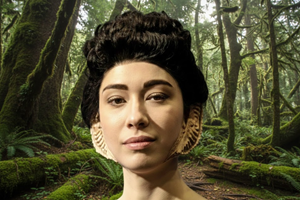 The Vorta are universally recognized as the cunning administrative and diplomatic face of the Dominion, but their origins trace back to a primitive, tree-dwelling existence on Kurill Prime. Originally small, timid, ape-like forest creatures who hid in hollowed-out trees to evade apex predators, their trajectory changed permanently upon encountering the Changelings. Genetically modified by the Founders to serve as premier tools of imperial conquest, the Vorta were engineered with distinct pale skin, violet eyes, elongated ear ridges granting enhanced hearing, and a natural immunity to most physical poisons. Some rare specimens were even endowed with the innate capability to channel telekinetic pulses. Conversely, the Founders intentionally left them with weak eyesight and a severely limited sense of taste and aesthetics — evolutionary dampeners designed to prevent them from ever questioning the absolute, utilitarian rule of the Dominion.
While outside civilizations often mistook them for the true rulers of the empire, the Vorta operated strictly as commanders, scientists, and diplomats under the supreme authority of their living gods. They also served as the primary explorers of the Gamma Quadrant. In 2298, a Vorta science vessel launched from Kurill Prime on a scheduled four-year exploratory sweep into uncharted space. During the mission, the ship encountered a colossal, starbase-sized biological entity traveling through the vacuum under its own power. An investigation turned catastrophic when an accidental collision wedged the Vorta ship deep inside the creature's massive outer body structure. Finding the interior environment completely habitable, the crew broadcasted a localized distress signal.
When imperial rescue forces failed to arrive, the shipwrecked crew was forced to establish a permanent colony within the living leviathan. Unlike the single-gender Jem'Hadar, both male and female Vorta served aboard the expedition. Stranded without access to the Dominion's specialized cloning facilities, the colonists began pairing off, shifting to natural biological reproduction to sustain their isolated population over the subsequent generations.
In 2439, this massive spacefaring life-form — which the refugees named Tchema — spiritually and telepathically contacted the crew of the U.S.S. Enterprise-H, desperately pleading for Federation assistance to rid itself of the parasitic Vorta colony. When an Enterprise away team deployed to negotiate a peaceful relocation, the deeply defensive refugees launched a coordinated ambush on the landing party. Simultaneously, a radical Vorta youth attempted to surgically assault Tchema’s core neural pathways to make the giant entity more compliant to the colony's expanding infrastructure. Intervening just in time, the crew of the Enterprise successfully thwarted the assault, neutralized the hostile faction, and safely relocated the Vorta refugees to a suitable, uninhabited Class M world, finally allowing Tchema to resume its peaceful journey through the cosmos.
Wadi
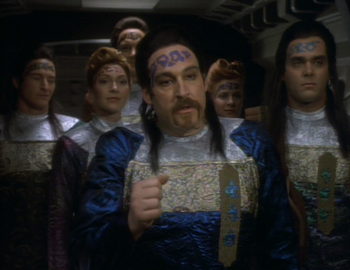 The Wadi, who refer to themselves as "the People" in their native tongue, are a highly advanced and enigmatic humanoid species originating from the Gamma Quadrant, primarily based in the Tomerela system on the planet Oason. Physically, they closely resemble humans in stature, though their appearance is marked by distinct purple ink symbols painted on their foreheads and bodies, serving as clan markings. Their skin tones range from white to dark brown, with hair color varying from blond to black. While their corporeal forms appear standard, Wadi society is deeply rooted in an obsession with competition, risk, and the pursuit of mastery through games. This cultural fixation is so pervasive that it governs their political structure; leadership is not decided by traditional elections or heredity, but by victory in complex tournaments. Those who achieve the highest levels of game mastery are awarded the title of "Master Surchid."
Their technology is remarkably sophisticated, possessing capabilities that often border on the impossible. They utilize advanced holographic fields and "Chula" technology, which allows for the creation of intricate, immersive virtual environments or pocket dimensions that can trap individuals as active game pieces. These systems are powered by highly guarded advancements in matter manipulation and transport, which are potent enough to neutralize military threats. In fact, their technological prowess — and perhaps their latent psionic abilities, present in roughly 3% of their population — has allowed them to remain an independent state, successfully repelling Dominion aggression by simply transporting hostile Jem'Hadar fleets to the edge of their star system. Despite this power, they remain whimsical, often communicating in cryptic rhymes and songs, which other species frequently misinterpret as a sign of flightiness or a cover for sinister intent.
The Wadi were the first Gamma Quadrant power to send a formal diplomatic delegation through the Bajoran wormhole, arriving at Deep Space 9 in 2369. Their visit was characterized less by formal diplomacy and more by an interest in gambling at Quark's Bar. When a dispute arose over perceived cheating, the Wadi leader, Master Surchid Falow, subjected several Starfleet officers to a perilous game of Chula. While the Wadi maintain that these games are intended to be harmless diversions, their competitive nature demands that they teach "lessons" to those they believe have crossed them. Despite these frictions, they are not considered a threat to Dominion expansion, as they prefer the pursuit of leisure and entertainment over military conquest. For the Wadi, life is a grand, infinite game, and they continue to traverse the galaxy in search of new challengers, complex puzzles, and diverse diversions to alleviate their profound boredom.
Yaderan
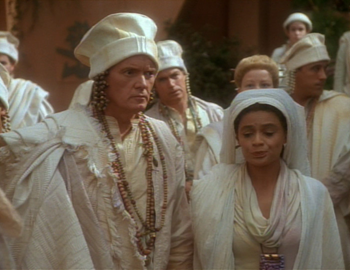 The Yaderans are a technologically advanced humanoid species from the Gamma Quadrant who were subjugated by the Dominion approximately 35 years ago. Prior to their annexation, Yaderan society was defined by an idyllic, communal philosophy, where citizens prioritized the collective over the individual under the belief that one could "fly higher with a thousand pairs of wings than with just one." Their civilization was a unified, fledgling interstellar state focused on internal growth and artistic expression, with architecture designed to symbolize that no societal group was inherently superior to another.
The Dominion invasion in 2340 was fast and brutal, resulting in the loss of many lives and the systematic erasure of the native way of life. The Founders specifically targeted the Yaderans for their unparalleled expertise in artificial intelligence, simulation technology, and omicron radiation-emitting holotechnology. To ensure compliance, the Vorta established a rigid class structure: surviving scholars and scientists were offered a luxuriously decadent lifestyle in exchange for their cooperation, while the less-educated masses were relegated to labor camps or forced into a slave class to serve the new elite. Many Yaderans who refused to accept this status quo chose to flee the homeworld or committed suicide in protest, leaving behind a fractured population where the once-united spirit of the people has been all but obliterated.
Since their forced incorporation into the Dominion, the Yaderan people have provided critical advancements that have fundamentally altered Dominion military capabilities. They have revolutionized cloak-detection technologies, most notably developing the anti-proton scanning system that is now standard on all Jem’Hadar vessels. Furthermore, the Vorta integrated Yaderan artificial intelligence and simulation models into Dominion devices, creating highly effective tools for espionage and sophisticated recreation among the empire's elite member races.
The cost of this collaboration has been catastrophic, characterized by deep-seated guilt among the new elite who thrive even as their former friends and neighbors wallow in misery. The most harrowing example of their subjugation is the development of the "sun-killer" bomb, a weapon designed to weaponize a star and destroy entire solar systems. During the development and testing of this technology, the Founders displayed their ruthless disregard for the species by insisting on using inhabited Yaderan colonies as live-fire targets. It took eleven successful tests—and the destruction of eleven populated systems—to perfect the device. Today, Yadera Prime exists as a shell of its former self, a society defined by a grim hierarchy of survival where the brilliance of its greatest minds is perpetually chained to the expansionist goals of the Dominion.
Categories: No categories found