Project Longshot
Created by Commodore Wilkan Targaryen on Tue May 12th, 2026 @ 12:09am
 Project Longshot is Starfleet’s inaugural deep-space initiative, established to secure a permanent presence across all four quadrants. Beginning with the launch of a series of deep space probes, the project has evolved from centuries of autonomous telemetry into modern, self-sustaining Expeditionary Task Groups dedicated to deep space exploration.
History
The Longshot Doctrine
In the decades following the Federation's birth in 2161, Starfleet Command established Project Longshot as its foundational deep-space initiative. Driven by the "Longshot Doctrine" — the belief that the Federation’s mandate required a permanent presence in every quadrant of the Milky Way — the project was organized into specialized divisions. While other initiatives focused on the Alpha and Beta frontiers, the Gamma Quadrant division of Project Longshot was tasked with the most ambitious "blind" reconnaissance in Starfleet history.The cornerstone of Project Longshot was the Quadros-1 probe, launched in 2193 with the singular mission of charting the Gamma Quadrant. As a high-endurance telemetry platform, it was designed to endure a multi-century journey to the galactic "far side." Its flight path was meticulously plotted to bring it near multiple quasars during its journey, using gravitational assists to sustain its relativistic momentum without exhausting its power reserves. Throughout its silent transit, Quadros-1 remained dedicated to its primary objective: the systematic mapping of Gamma Quadrant star systems, such as the Idran system. The probe’s multispectral scans captured precise stellar coordinates and atmospheric signatures from as far as 70,000 light-years away, transmitting this data back to Earth in periodic burst signals. This telemetry was captured by Starfleet's subspace arrays and integrated into the master navigational databases as the definitive (and only) record of the quadrant.
By the mid-24th century, the results of this dedicated Gamma Quadrant mission were pre-loaded into the computers of every Starfleet vessel as standard navigational background. This ensured that even small craft, such as the U.S.S. Rio Grande, carried the legacy of the 2193 mission. When the Bajoran Wormhole was discovered in 2369, it was the specialized, centuries-old focus of Quadros-1 that allowed Starfleet to immediately identify the Idran system, turning a 200-year-old gamble into a strategic triumph.
The Gold Rush
The discovery of the Bajoran Wormhole in 2369 transformed the Gamma Quadrant into the Federation’s most active frontier. This era, characterized by a frantic "Gold Rush" of activity, saw Project Longshot transition from centuries of passive telemetry into a high-stakes manned operation. Following the confirmation of the Idran system by the crew of Deep Space 9, Starfleet Command authorized a rapid exploration initiative. Because the "Longshot Doctrine" emphasized a permanent presence, Starfleet utilized the versatile Danube Class runabout as its primary vanguard. Ships like the U.S.S. Rio Grande, U.S.S. Ganges, U.S.S. Yangtzee Kiang, and U.S.S. Orinoco conducted dozens of "short-hop" missions, establishing the first sensor nets beyond the wormhole’s terminus.This expansion moved far beyond Starfleet's military and scientific oversight. While Project Longshot provided the navigational framework, civilian interests — driven by Bajoran spiritualism, Ferengi commerce, and scientific curiosity — fostered a diverse Federation presence. The Bajoran people founded the New Bajor colony in 2370 as a symbolic reclamation of their destiny, marking the first successful Alpha Quadrant settlement in the region. Simultaneously, the Ferengi Alliance, led by Grand Nagus Zek, aggressively pursued trade with the Karemma and the Dosi, viewing the quadrant as an untapped market of sub-quadrant commerce. Scientific and archaeological exploration was equally varied. Independent researchers and Starfleet teams sought to uncover the mysteries of abandoned Hur'q outposts and the legendary Iconian Gateway on Vandros IV. These missions provided vital data on historical trans-quadrant migration and led to rapid First Contacts with indigenous species such as the Wadi, the Tosk, and the Rakhari. During this window, the Gamma Quadrant was a mosaic of peaceful exchange, with Deep Space 9 serving as the bustling hub for this unprecedented inter-quadrant migration.
The era of unhindered expansion was, however, brief. In late 2370, the first whispers of the Dominion surfaced. The total destruction of the New Bajor colony and the subsequent loss of the Galaxy Class U.S.S. Odyssey brought the Gold Rush to a violent end. Following the Odyssey’s destruction, the environment turned overtly hostile. Between 2371 and 2373, Alpha Quadrant vessels — including both civilian transports and Starfleet ships on scientific assignments — increasingly came under direct attack by Dominion forces. These predatory strikes by Jem'Hadar patrols signaled that the Founders viewed any presence in the Gamma Quadrant as a territorial infringement. Starfleet shifted to a defensive posture, deploying the U.S.S. Defiant to conduct covert intelligence gathering rather than open scientific survey and civilian travel became strictly restricted.
The era officially concluded in 2373. As the Dominion allied with the Cardassian Union and began moving massive fleets into the Alpha Quadrant, the Federation took the unprecedented step of mining the wormhole's entrance. This act established a total "lockdown" of the Gamma Quadrant, cutting off all civilian and scientific initiatives. While the Dominion were able to dismantle the minefield during their brief occupation of Deep Space 9, Project Longshot’s manned operations remained suspended, and the frontier was abandoned to the shadows of conflict for the duration of the Dominion War.
Reconciliation
Following the signing of the Treaty of Bajor in 2375, Starfleet moved to reactivate Project Longshot, shifting the mission from wartime defense to a strategy of "Peaceful Reconciliation." With the Female Changeling convicted of war crimes and incarcerated at Ananke Alpha, the Federation anticipated a new era of diplomatic stability. In these immediate post-war years, the Longshot Doctrine focused on humanitarian aid, utilizing the wormhole to provide relief to worlds devastated by the Dominion’s retreat. By 2380, while the Federation was preoccupied with the Andak Project on Cardassia and rising Pakled aggression, Project Longshot began deploying California Class starships to the Gamma Quadrant. These vessels were tasked with "Second Contact" procedures, re-establishing the vital trade and diplomatic ties with the Karemma and Dosi that had been severed during the conflict.The geopolitical landscape of the Alpha Quadrant eventually began to impact these deep-space operations. As the Romulan Empire fractured into the Imperial Romulan State under Empress Donatra and the provisional government on Romulus, Starfleet’s resources were increasingly diverted to maintain the Neutral Zone. Despite the internal chaos of the Great Schism and the Klingon seizure of Romulan worlds, Project Longshot managed to maintain a small scientific presence. This era saw a brief technological surge, with the commissioning of A500 synthetic laborers to assist in the construction of new exploratory platforms; however, the project suffered a catastrophic setback in 2384 during the Protostar Crisis, when a Vau N’Akat weapon caused massive sub-network damage across the fleet. The resulting instability forced a temporary recall of Longshot’s forward-deployed assets to the Bajoran sector.
The definitive end of Project Longshot’s post-war revival came in 2385 following the attack on Mars. Rogue synthetics destroyed the Utopia Planitia Fleet Yards and the Romulan rescue armada, leading to an immediate and total Synthetic Ban. The loss of the rescue fleet and the subsequent resignation of Admiral Jean-Luc Picard left Starfleet depleted and politically isolated. In the wake of the Mars tragedy and the growing hostility of the Klingon Empire, the Federation Council adopted a policy of isolationism, and Project Longshot was officially de-prioritized. Manned expeditions beyond the wormhole were suspended indefinitely to consolidate resources for the defense of the core worlds. For the second time in a decade, the Gamma Quadrant became a silent frontier, with Starfleet maintaining only a skeleton sensor watch at Deep Space 9. The dream of a permanent, self-sustaining presence was mothballed, waiting for a future era to reclaim the long-range goals originally established by the Quadros-1 pioneers.
The Long Walk
Following the long silence that began with the Mars tragedy, the "Longshot Doctrine" remained a dormant philosophy until the 2410s. The initial catalyst for re-engagement was the awakening of the Hur'q, a resurgent threat that forced a desperate alliance between the Khitomer Alliance and Odo’s Dominion. Following the successful defeat of the Hur'q, Starfleet attempted to capitalize on this newfound cooperation by establishing a permanent foothold in the Gamma Quadrant. This led to the relocation of the former Cardassian station Empok Nor to the Gamma terminus of the wormhole to serve as Deep Space 47, Starfleet's forward operational hub.Despite these logistical achievements, the window for formal cooperation quickly closed. Rogue Jem'Hadar forces launched a series of violent attacks on Deep Space 9, causing formal peace talks with the Great Link to collapse entirely. While the infrastructure of Deep Space 47 remained, the agreement for continued, wide-scale exploration was never reached. This forced the Federation to pull back into a restricted, tactical posture for several decades, maintaining a skeleton watch over the quadrant while the "Longshot Doctrine" once again waited for a favorable political climate.
In 2439, the Enterprise-H spearheaded a historic turning point for Project Longshot after rescuing a crippled Dominion vessel in the Gamma Quadrant. Carrying a high-level delegation led by the legendary Founder Odo, the vessel had been ravaged by a biological progenitor entity to the Founders. This timely intervention catalyzed the 2439 Gamma Non-Aggression Pact, the first formal peace treaty between the Dominion and the United Federation of Planets since the Dominion War. Consequently, Starfleet authorized a renewed five-year exploratory mission to the region. Operating from Deep Space 47, these crews now lead "The Long Walk," representing Federation interests on this vast, beckoning frontier that remains as lethal as it is beckoning.
Mission Overview
During Starfleet's deep-space initiatives in the Gamma Quadrant, Project Longshot utilizes specialized starships to navigate situations ranging from peaceful first contact to high-stakes strategic deterrence. Operating tens of thousands of light-years from their home territory, Starfleet maintains a permanent rotation of vessels to conduct forward presence operations, shape the frontier's strategic environment, and build interoperability with cooperative local powers. To maximize sector coverage, individual vessels frequently "disaggregate" from the group flagship to perform independent survey and scientific missions across vast distances.The 7 core mission objectives of Project Longshot include:
- Scientific Discovery and Structural Presence: Conducting deep-space exploration and maintaining a highly visible Federation presence capable of operating through hazardous cosmic environments, uncharted planetary systems, or dense stellar phenomena.
- Zone and Navigational Control: Gaining and maintaining long-term stability and operational freedom across critical corridors, including wormhole termini, celestial choke points, bounded sectors, and the open void to ensure safe passage for all peaceful starships.
- Protection of Trade, Colonization, and Surface Support: Ensuring the comprehensive safety of civilian colony worlds, scientific outposts, and shipping lanes against external threats, while providing orbital coordination, logistical transport, and environmental shielding to safeguard teams during hazardous surface operations.
- Humanitarian Assistance and Disaster Relief (HA/DR): Deploying immediate medical triage, life-support logistics, and planetary support to respond to localized crises and severe environmental or subspace catastrophes within the Gamma Quadrant.
- Multi-Spectrum Surveillance, Intelligence, and Command: Utilizing advanced sensor networks to maintain a comprehensive operational picture of spaceborne hazards or hidden signatures, while serving as the central administrative hub to direct assigned Starfleet units and cooperative allied forces.
- Atmospheric, Orbital, and Planetary Defense: Establishing absolute operational security over designated airspace to protect vulnerable teams, isolate hazardous anomalies, and deploy localized interception fields to shield assets from long-range orbital bombardments or incursions.
- Diplomatic Engagement and Strategic Presence: Supporting Federation diplomacy through joint scientific exchanges with indigenous species, normal peacetime charting operations, and controlled defensive deployments to reinforce the Gamma Non-Aggression Pact and de-escalate hostilities.
Deployment Force Composition
Project Longshot Flagship
U.S.S. Enterprise NX-1701-H
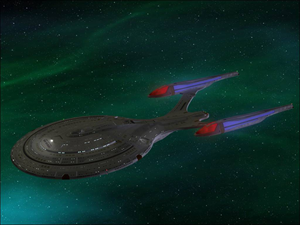 The Century Class design emerged from strategic needs following major conflicts, eventually finalized as Starfleet's premier multi-role flagship. Built under an aggressive, modular "concurrency" strategy at the San Francisco Fleet Yards, the prototype initially suffered severe development hurdles. Integrating numerous immature technologies mid-build caused rolling power blackouts and grid cascades, forcing a late-stage transition to an experimental Coaxial Warp Drive to stabilize its massive power network.
Following the tragic loss of the Enterprise-G at the Battle of the Foundry, Starfleet redesignated the vessel as the U.S.S. Enterprise NX-1701-H. Under the permanent command of Commodore Wilkan Targaryen, engineers resolved persistent software patches and subspace field bleeding by stripping non-essential sub-systems. This massive "mobile Starfleet Headquarters" features a distinctive ovoid primary hull reinforced with Neutronium Alloy Fibers for direct planetary landings, utilizing the Artificial Intelligence Monitoring System (AIMS) for high automation.
Now fully certified after surviving relentless Typhon Pact cyber-assaults in the Sol System, this floating sovereign territory serves as the standard-bearer for frontier exploration. Operating from Deep Space 9 under the Treaty of Bajor, the flagship crossed into the Gamma Quadrant, where rescuing the legendary Founder Odo brokered an unprecedented peace treaty. The Enterprise-H has deployed on a historic five-year mission to explore the Gamma Quadrant with the Dominion's blessing.
For more information on the U.S.S. Enterprise-H, please see the Project Longshot LCARS Database.
Project Longshot Defense Squadron
U.S.S. Majestic NCC-124105
 Commissioned in 2432 alongside its prototype sister ship, the U.S.S. Majestic was rushed into active service to provide immediate tactical muscle along the heavily fractured Federation frontier. Built to the same exacting combat specifications as the Valiant, the Majestic served as a critical line of defense during the 2433 Tzenkethi Blockade.
When a heavy Tzenkethi dreadnought task force attempted to seal off the Denorios Belt and trap the abandoned hull of Deep Space Nine, the Majestic was deployed to execute high-speed, close-quarters maneuvers, using its quad pulse phaser cannons to harass enemy lines alongside the newly launched Defiant-C.
The ship’s history is defined by brutal, short-range border enforcement and high-recharge shield hardening. Unlike standard cruisers, the Majestic sacrifices luxury for raw combat readiness and advanced passive electronic countermeasures, making it exceptionally lethal in plasma storms and asteroid fields. Within the Gamma Quadrant Task Force, the Majestic functions as a primary escort leader, protecting vulnerable science vessels and surveyors from aggressive local factions like the Drai or rogue Jem'Hadar splinters.
U.S.S. Valiant NX-123776
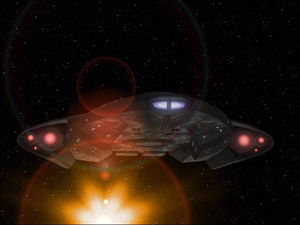 The U.S.S. Valiant is the trailblazing prototype of its class, commissioned in 2432 as a direct strategic response to the rising external threats of the 2420s. Engineered at the Bajoran Okana Shipyards as a proof-of-concept for heavily armored, frontline starships, the Valiant was designed to ensure Starfleet would never again be paralyzed by the tactical density of adversaries like the Niljaad Dictatorship or the Typhon Pact.
Visually, this "pocket battleship" is a direct descendant of the Defiant lineage, featuring an ultra-low profile, an over-built frame, and heavily armored, integrated nacelles that minimize its targeting signature in high-intensity skirmishes. The Valiant is built entirely around a massive power core that feeds devastating quad forward-facing pulse phaser cannons and an integrated ablative armor matrix.
Despite its hyper-focused tactical role, the Valiant boasts an expanded internal volume compared to its 24th-century predecessors, allowing its crew of 66 to maintain independent border patrols for up to two years. As a prototype, the Valiant has spent its early years testing next-generation passive countermeasure suites, making it the task force's premier heavy-response vanguard.
U.S.S. Vigilance NCC-123450
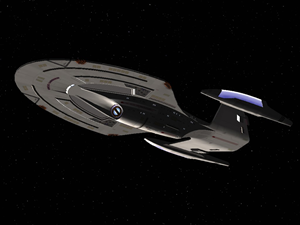 The U.S.S. Vigilance represents the absolute apex of deep-space authority and long-range reconnaissance within Starfleet. Commissioned in 2432 as a definitive, modern successor to the legendary Pathfinder and Intrepid lineages, the Vigilance was built to operate for years at the absolute edge of known space without traditional starbase support.
Retaining the iconic, organic "arrowhead" aesthetic, its streamlined primary hull is paired with highly sophisticated, variable-geometry warp nacelles that dynamically shift to reconfigure the warp field, dramatically conserving fuel at high velocities. The Vigilance played a critical role during the 2434 Slipstream Standoff, utilizing its Quantum Slipstream Burst Drive to outmaneuver Romulan Free State vessels attempting to claim natural slipstream navigation data from the long-lost wreckage of the U.S.S. Hera.
With an advanced sensor suite optimized for "Deep Space Awareness," the Vigilance is capable of detecting anomalous phenomena and cloaked incursions long before they pose a physical threat. Operating with a streamlined crew of 400 and full planetfall capability, the Vigilance acts as the primary long-range scout for the task force, probing deep into unmapped Gamma Quadrant sectors.
Project Longshot Exploratory Squadron
U.S.S. Cairo NCC-108402
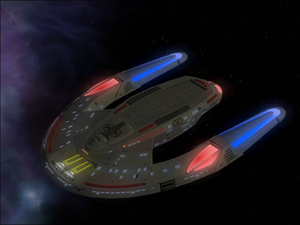 The U.S.S. Cairo has a long and storied operational history, serving as one of the earliest examples of the Vulcan-engineered Gol class. Originally commissioned in 2414, the Cairo was designed to meet a critical strategic necessity: bridging the operational gap between light, nimble tactical escorts and long-range frontier patrol vessels.
Named after the historic Earth cultural center, the vessel features the signature Gol class aesthetic — a compact, crescent-shaped primary hull that integrates the warp nacelles directly into its sweeping, curved structure, entirely omitting a traditional secondary engineering hull. Built with a reinforced skeletal frame to withstand the immense structural stress of rapid deployment, the Cairo spent its early decades performing high-endurance border enforcement.
During the fleet-wide upgrades of the mid-2420s, its secondary tactical bays were reconfigured to house advanced modular laboratories and high-resolution sensor suites, transforming it into an indispensable asset for deep-space awareness. With a streamlined crew of 280 prioritizing technical precision over luxury, the Cairo represents decades of reliable Vulcan design efficiency, making it an ideal choice to provide localized sector command and electronic oversight within the volatile Gamma Quadrant Task Force.
U.S.S. Zefram Cochrane NCC-126314
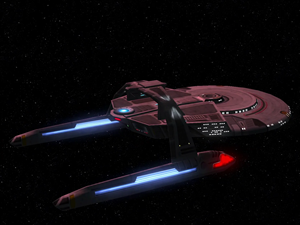 Launched in 2434, the U.S.S. Zefram Cochrane represents the definitive 25th-century evolution of Starfleet's most enduring and versatile spaceframe. Engineered to succeed the older Reliant class, the Zefram Cochrane was built during a period of intense post-war reconstruction to serve as the critical connective tissue for fleet logistics.
Sporting the distinctive yellow hull signage and striping of the Operations division, the vessel features a modernized, heavy-duty dorsal "roll-bar" weapon platform housing advanced sensor arrays and torpedo launchers. Beneath this roll-bar sits a flat, modular deck that allows the ship to rapidly swap massive cargo and engineering modules.
During the 2435 Vaadwaur War, the Cochrane was vital in transporting salvaged Cardassian structural components into the Denorios Belt to accelerate the rebuilding of Deep Space Nine. Equipped with a robust power architecture and an integrated, burst-rated quantum slipstream projector, the ship combines rapid strategic transit with rugged, field-serviceable durability. Within the task force, the Zefram Cochrane serves as the primary engineering and logistical anchor, ensuring the fleet remains fully supplied.
U.S.S. Hood NCC-122234
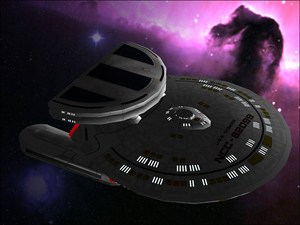 The U.S.S. Hood was launched in 2431 as part of Starfleet's post-Armada War modernization period, a critical era when the Federation needed to rapidly replace its heavily decimated explorer fleet with adaptable, mid-tier hulls. Colloquially known to its crew as a "Pocket Nebula," the Hood integrates the proven, rugged geometry of the classic Nebula class lineage into a significantly more compact and maneuverable frame.
The defining feature of the Hood is its massive, external Dorsal Mission Configurable Pod. Rather than relying on fixed internal facilities, the Hood can completely alter its operational identity at a starbase by swapping this pod. Throughout the early 2430s, the ship served on the front lines of the Typhon Pact cold war, frequently refitted with advanced tactical sensor pallets to track Tholian and Romulan Free State fleet movements along the frontier.
Protected by a high-output Metaphasic Shield Grid, the Hood proved its resilience by surviving numerous plasma-storm skirmishes. For its web-like defensive capabilities and operational flexibility, the Hood was selected for the Gamma Quadrant Task Force, where it currently utilizes a specialized long-range astrometrics pod to map uncharted anomalies.
U.S.S. John Kelly NCC-127053
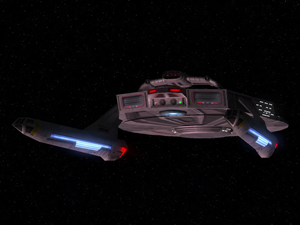 The U.S.S. John Kelly is the newest Miranda IV hull assigned to the task force, commissioned in 2436 amidst the tense fallout of the Vaadwaur War and the imposition of the Typhon Pact’s "Iron Curtain." Bearing the red hull signage of the Command and Diplomatic division, the John Kelly was uniquely configured to serve as a high-capacity armored envoy and security transport.
Its flat dorsal deck houses a reinforced diplomatic suite and advanced secure-communication matrices, allowing it to host high-stakes political summits in volatile sectors. Its early history was defined by the 2436 Ferengi Tariff Crisis; the John Kelly was deployed to escort vulnerable merchant convoys past aggressive Klingon Birds-of-Prey conducting live-fire drills along trade corridors.
Featuring a burst-rated quantum slipstream projector and an upgraded tactical suite built into its modernized roll-bar, the John Kelly provides a perfect balance of defensive durability and diplomatic prestige. Within the Gamma Quadrant Task Force, it serves as an essential liaison vessel, managing complex logistical coordination and security protocols between Starfleet command and local alien factions.
U.S.S. Alfred Nobel NCC-127871
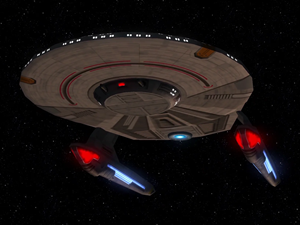 Commissioned in 2435, the U.S.S. Alfred Nobel wears the blue striping of the Scientific division, engineered specifically to serve as a long-range survey vessel and planetary research platform. Utilizing the Miranda IV's heavy-duty dorsal roll-bar to house high-intensity astrometric and planetary sensor arrays, the Alfred Nobel excels at deep-space data acquisition.
During the frantic search for the Vaadwaur’s automated "Foundry" shipyard, the Alfred Nobel was part of the specialized fleet segment that mapped the massive nexus of Underspace Conduits within the Azure Nebula, deploying heavy defense platforms to bottleneck enemy reinforcement flows.
The vessel's robust power architecture allows it to route immense energy from its warp core directly into its sensor pallets, enabling it to penetrate dense nebulae or severe subspatial interference that would blind standard cruisers. Now assigned to the Gamma Quadrant Task Force, the Alfred Nobel acts as a dedicated scientific explorer, working in tandem with heavy scouts to analyze exotic resource veins and temporal anomalies across the wormhole.
U.S.S. Louis Pasteur NCC-127052
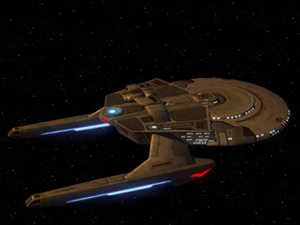 The U.S.S. Louis Pasteur was commissioned in 2435, instantly recognizable by the striking blue hull signage and striping denoting its assignment to Starfleet’s Medical and Scientific divisions. Built upon the highly adaptable Miranda IV modular spaceframe, the Louis Pasteur is outfitted with a specialized, state-of-the-art mobile field hospital and primary triage module on its flat dorsal deck.
This configuration was put to a grueling live-fire test almost immediately after launch, when the Vaadwaur Sovereignty emerged from the Underspace networks and launched a brutal kinetic bombardment against the Romulan Free State world of Rator III. The Louis Pasteur worked directly alongside the Enterprise-G during the chaotic evacuation, rescuing thousands of civilian refugees and managing catastrophic bio-environmental casualties under heavy fire.
Powered by a high-output core capable of driving advanced bio-regenerative containment shields, the ship is an indispensable humanitarian asset. For the Gamma Quadrant Task Force, the Louis Pasteur stands ready as a premier medical relief vessel and a mobile laboratory, capable of analyzing exotic, alien pathogens on the frontier.
U.S.S. Resolute NCC-124488
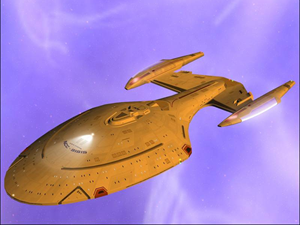 The U.S.S. Resolute was commissioned in 2433, entering a galaxy deeply scarred by the DS9 Red Orb cataclysm and the resulting political upheaval. Built to the high-autonomy standards of the Intrepid II class, the Resolute was designed to serve as a beacon of Federation presence along the outer rim. When the newly elected President Sayonni Alval enacted the Frontier Autonomy Act in 2434, the Resolute became an essential asset for regional logistical command, helping decentralized outer-rim sectors deploy their local defense nets.
Technologically, the Resolute is a masterclass in deep-space data mining, boasting multi-disciplinary laboratories that allow its 400-person crew to conduct complex scientific research without starbase support. Its variable-geometry warp nacelles and Quantum Slipstream Burst Drive provide unparalleled speed and efficiency, which proved vital when intercepting Breen transport convoys hauling black-market Borg technology.
With full planetfall capabilities and reinforced landing struts, the Resolute specializes in primary diplomatic stabilization and first-contact protocols, making it a highly valued, versatile asset for the multi-faceted mission profiles of the Gamma Quadrant Task Force.
U.S.S. ShirKahr NCC-109917
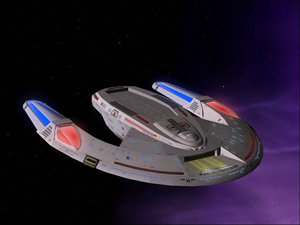 Commissioned in 2417, the U.S.S. ShirKahr is named after the ancient capital of Vulcan, perfectly embodying the logical and disciplined engineering principles of its creators. Like its sister ship, the Cairo, the ShirKahr utilizes a compact crescent silhouette designed to maximize warp field stability during high-energy tactical maneuvers. This unique geometry allowed the vessel to maintain perfect sensor clarity and communication lock-on while executing high-speed intercepts during the chaotic proxy conflicts of the 2420s.
When the automated logistics networks failed and civil unrest sparked localized riots throughout the Federation core, the ShirKahr was frequently deployed as a rapid-response peacekeeper, using its over-engineered frame to stabilize isolated outposts.
Following its mid-life modernization, which swapped out raw weaponry for uprated scientific arrays, the ShirKahr excelled at independent picket duties. It spent years mapping the edges of the Coalsack Nebula and monitoring the "Cardassian Wall" during the height of Legate Niljaad's militaristic grandstanding. Now assigned to the Gamma Quadrant Task Force, the ShirKahr brings over two decades of robust frontier experience, acting as a reliable mobile sensor platform and a stoic deterrent against regional hostiles.
U.S.S. Victory NCC-122862
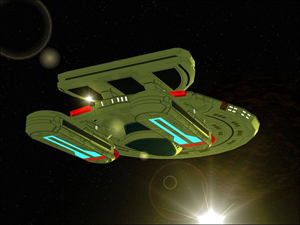 The U.S.S. Victory carries a storied legacy of resilience, entering active service in 2431 alongside its sister ship, the Hood, to address the urgent logistical bottlenecks facing the outer rim. Built with a sturdy primary saucer and a tightly integrated secondary engineering hull, the Victory was engineered to perform intensive border stabilization and infrastructure repair.
During the tumultuous events of the 2432 Trojan Summit sabotage and the subsequent Nausicaan invasion, the Victory was deployed to the volatile Sierra Sector. There, configured with a heavy mobile triage and emergency cargo pod, the vessel successfully managed massive refugee populations fleeing displaced privateer networks.
When the Cestus Mandate activated its planetary defense nets and Grand Nagus Praag’s blockade-runners fractured the outer-rim trading corridors, the Victory maintained a threadbare Starfleet presence, using its Metaphasic Shield Grid to withstand direct fire from rogue privateers. The Victory's history is defined by its ability to hold the line under extreme duress. Its assignment to the Gamma Quadrant Task Force leverages this exact operational durability, serving as a heavily armed logistical anchor and a mobile command post for deep-space sorties.
Categories: No categories found