Enterprise Spacecraft
Created by Commodore Wilkan Targaryen on Fri Apr 3rd, 2026 @ 2:44am
Early Earth Spacecraft
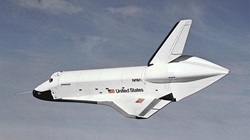 | |
| Affiliation: | United States of America |
| Class: | Space Shuttle Orbiter |
| Service Period: | 1976-1977 |
| Complement: | 8 personnel |
| Fate: | Museum |
Enterprise OV-101
The Space Shuttle Enterprise (OV-101) was the first orbiter of the Space Shuttle system, rolled out on September 17, 1976. Originally to be named Constitution, a massive letter-writing campaign persuaded President Gerald Ford to rename the craft Enterprise. While it lacked engines and a functional heat shield for orbital flight, it served as the critical testbed for the entire program.In 1977, Enterprise conducted the Approach and Landing Tests (ALT) at Edwards Air Force Base. Carried atop a modified Boeing 747 Shuttle Carrier Aircraft, it was released at altitude to prove the orbiter could fly as a massive unpowered glider and land safely on a runway. These tests, piloted by crews including Fred Haise and Joe Engle, validated the fly-by-wire controls and aerodynamic design essential for the future of reusable spaceflight.
Following the conclusion of its flight tests, Enterprise was used for "fit checks" at Kennedy Space Center and Vandenberg Air Force Base to ensure launch pads were correctly configured for the flight-ready orbiters. Plans to refit Enterprise for spaceflight were considered but ultimately deemed too expensive compared to building Challenger from a structural test article.
Today, Enterprise resides at the Intrepid Sea, Air & Space Museum in New York City. As the physical bridge between science fiction and aerospace reality, it remains a symbol of human aspiration. A model or painting of OV-101 is traditionally displayed in the "Senior Officer's Wardroom" of every starship Enterprise, honoring the 20th-century craft that proved wings could take humanity to the stars.
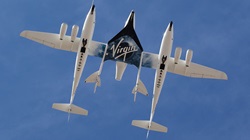 | |
| Affiliation: | Virgin Galactic |
| Class: | SpaceShip Two |
| Service Period: | 2010-2014 |
| Complement: | 3 personnel |
| Fate: | Destroyed |
V.S.S. Enterprise
The VSS Enterprise (tail number: N339SS) was the first SpaceShipTwo (SS2) commercial suborbital spacecraft, built by Scaled Composites for Virgin Galactic. Unveiled in December 2009, the vehicle was designed to carry two pilots and six passengers to the edge of space. It utilized a unique "feathering" tail system, which allowed the craft to rotate its twin tail booms upward to create high drag for a stable, belly-first reentry into the atmosphere.During its development program, the Enterprise successfully completed dozens of glide tests and several rocket-powered flights, reaching supersonic speeds and altitudes exceeding 70,000 feet. These tests were critical in validating the hybrid rocket motor technology and the carbon-composite airframe designed to withstand the stresses of suborbital flight.
On October 31, 2014, during its fourth powered test flight, the Enterprise suffered a catastrophic in-flight breakup over the Mojave Desert. An investigation by the National Transportation Safety Board (NTSB) determined that the feathering system was manually unlocked prematurely during the boost phase, causing the ship to disintegrate under aerodynamic loads. The accident resulted in the death of co-pilot Michael Alsbury and serious injuries to pilot Peter Siebold.
Despite the tragic loss of the vehicle and a crew member, the VSS Enterprise remains a foundational chapter in the history of private space exploration. The lessons learned from its flight data and the subsequent investigation led to significant safety overrides and design improvements in its successor, the VSS Unity, ensuring that the pursuit of commercial spaceflight continued with a more robust understanding of high-altitude aerodynamics.
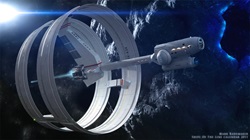 | |
| Affiliation: | United Earth |
| Class: | Declaration |
| Service Period: | 2123-2150 |
| Complement: | 35 officers and enlisted |
| Fate: | Destroyed |
U.S.S. Enterprise (XCV 330)
The U.S.S. Enterprise (XCV 330), also known as the Declaration-class cruiser, represents a pivotal era in human interstellar travel during the mid-22nd century. Utilizing a radical annular warp drive design, the vessel was characterized by its distinctive large ring-shaped engine nacelles which surrounded the central pressurized hull. This configuration was based on the Vulcan-influenced "ring-ship" philosophy, predating the dual-nacelle design that would eventually become the Starfleet standard.Operating in the years following World War III (2026–2053) and the historic first contact with the Vulcans in 2063, the XCV 330 served as one of Earth's first true long-range explorers. During the fragile reconstruction period of the late 21st and early 22nd centuries, the ship was tasked with charting the neighboring star systems and establishing the early infrastructure for what would eventually become the United Federation of Planets.
The XCV 330 is perhaps best remembered as a historical bridge. It moved humanity beyond the "Post-Atomic Horror" and the localized conflicts of the Eugenics Wars, transitioning Earth from a planet scarred by nuclear exchange into a spacefaring civilization. While its top speeds were modest compared to later vessels, its successful missions proved that human crews could survive and thrive during multi-year deep-space assignments.
A painting or model of the XCV 330 is traditionally displayed in the "senior officer's gallery" of subsequent ships named Enterprise, including the NX-01 and the NCC-1701. It stands as a tribute to the generation of pioneers who utilized the first stable warp fields to lead humanity out of the darkness of the 21st century and toward the stars.
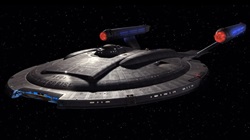 | |
| Affiliation: | United Earth United Federation of Planets |
| Class: | NX |
| Service Period: | 2151-2161 |
| Complement: | 83 officers and enlisted |
| Fate: | Museum |
U.S.S. Enterprise NX-01
U.S.S. Enterprise (NX-01) The U.S.S. Enterprise (NX-01) was the first NX-class starship and the first Earth vessel capable of reaching Warp 5, launched in 2151 under the command of Captain Jonathan Archer. As the flagship of United Earth Starfleet, it represented the pinnacle of human engineering following the recovery from World War III and the Post-Atomic Horror. Built at the San Francisco Fleet Yards, the NX-01 broke humanity’s reliance on Vulcan warp technology and opened the deep frontier.The vessel played a pivotal role in the mid-22nd century, most notably during the Xindi Crisis and the subsequent Earth-Romulan War (2156–2160). Serving as the tactical and diplomatic flagship for the coalition of Earth, Vulcan, Andorian, and Tellarite forces, the Enterprise led the defense of the Sol system. Its resilience against Romulan plasma-weaponry and cloaking prototypes during the Battle of Cheron proved that the nascent alliance could withstand a galactic superpower.
Following the signing of the Federation Charter in 2161, the Enterprise was decommissioned after ten years of service. Rather than being scrapped, the historic vessel was preserved as a primary exhibit in the Starfleet Fleet Museum at Athan Prime. There, it remains a permanent tribute to the pioneers of the warp era and the crew who bridged the gap between the radioactive oceans of the Eugenics Wars and the birth of the United Federation of Planets.
The NX-01 stands today as the definitive ancestor of the NCC-1701, symbolizing the moment humanity transitioned from a primitive, isolationist world into the heart of a vast interstellar community.
United Federation of Planets
 | |
| Affiliation: | United Federation of Planets |
| Class: | Constitution Constitution II |
| Service Period: | 2245-2285 |
| Complement: | 430 officers and enlisted |
| Fate: | Destroyed |
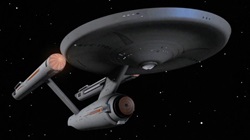
U.S.S. Enterprise NCC-1701
The U.S.S. Enterprise (NCC-1701) was a Constitution-class heavy cruiser, commissioned in 2245 at the San Francisco Fleet Yards. As the flagship of the United Federation of Planets, it became the most famous vessel in Starfleet history, representing the pinnacle of 23rd-century technology and diplomacy. Under the successive commands of Robert April, Christopher Pike, and most famously James T. Kirk, the ship spearheaded the Federation’s expansion into the Alpha and Beta Quadrants.Between 2265 and 2270, the Enterprise completed its historic five-year mission of deep-space exploration. During this period, the crew made first contact with dozens of new civilizations, survived the lethal M-5 multitronic unit tests, and faced the terrifying Planet Killer. The ship's tactical resilience was frequently tested in high-stakes skirmishes with the Klingon Empire and the Romulan Star Empire, often serving as the only line of defense for isolated Federation colonies.
In the early 2270s, the Enterprise underwent a massive refit, essentially rebuilding the ship from the keel up with linear warp drive nacelles and advanced phaser banks. This upgraded version successfully intercepted the V’Ger entity, preventing the assimilation of Earth. However, the ship’s storied career met a violent end in 2285 during the Genesis Crisis. To prevent the vessel from falling into the hands of Klingon Commander Kruge, Admiral Kirk initiated the auto-destruct sequence over the Genesis Planet.
The destruction of the NCC-1701 marked the end of an era, but its legacy was so profound that Starfleet broke tradition by issuing its successor the same registry number with an alphabetic suffix. The Enterprise remains the benchmark for all subsequent capital ships, proving that a single vessel, through the "bold undertaking" of its crew, could shift the course of galactic history and preserve the Federation's core values of peace and discovery.
 | |
| Affiliation: | United Federation of Planets |
| Class: | Constitution II |
| Service Period: | 2286-2293 |
| Complement: | 300 officers and enlisted |
| Fate: | Museum |
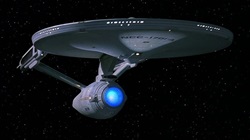
U.S.S. Enterprise NCC-1701-A
The U.S.S. Enterprise (NCC-1701-A) was a Constitution-class refit starship commissioned in 2286 at the Yorktown Starbase. Launched shortly after the events of the Whale Probe crisis, the vessel was a direct replacement for the original NCC-1701, which had been destroyed over the Genesis Planet. In a historic break from Starfleet protocol, the "A" was added to the registry to honor Admiral James T. Kirk and his crew for their role in saving Earth from ecological collapse.Though its early shakedown cruise was plagued by mechanical failures and system glitches, the 1701-A quickly proved its mettle as the Federation’s premier diplomatic flagship. In 2287, it was dispatched to Nimbus III, the "Planet of Galactic Peace," to resolve a hostage crisis involving the renegade Vulcan Sybok. This mission took the ship beyond the Great Barrier at the center of the galaxy, marking one of the most mysterious and controversial voyages in Starfleet records.
The ship’s finest hour came in 2293 during the Khitomer Conference. Amidst a conspiracy to prevent peace between the Federation and the Klingon Empire, the Enterprise-A — in coordination with the U.S.S. Excelsior — engaged and destroyed a prototype Klingon Bird-of-Prey capable of firing while cloaked. This victory ensured the signing of the Khitomer Accords, effectively ending decades of cold war and ushering in an era of unprecedented galactic stability.
Following the success at Khitomer, the Enterprise-A was decommissioned in 2293. While some reports suggest it was slated for the scrap heap, the vessel was ultimately preserved and placed in the Starfleet Fleet Museum at Athan Prime. It stands as a testament to the transition from an era of expansionist conflict to one of interstellar cooperation, ensuring that the Kirk era ended on a note of hard-won peace.
 | |
| Affiliation: | United Federation of Planets |
| Class: | Excelsior |
| Service Period: | 2293-2229 |
| Complement: | 750 officers and enlisted |
| Fate: | Lost |
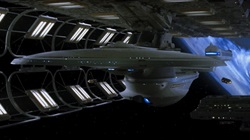
U.S.S. Enterprise NCC-1701-B
Launched in 2293, the U.S.S. Enterprise-B was a retrofit Excelsior-class cruiser commissioned to replace the retired Enterprise-A. Under Captain John Harriman, its maiden voyage ended in tragedy; while rescuing 47 El-Aurian refugees from a temporal ribbon, the ship suffered a hull breach that resulted in the presumed death of James T. Kirk.Despite this start, the Enterprise-B became a legendary flagship of exploration. It mapped over 142 star systems and made first contact with 17 civilizations, pushing the Federation’s reach far beyond the Gourami sector. Harriman remained in command until 2311, when the ship played a decisive role in the Tomed Incident. This confrontation with the Romulans led to the Treaty of Algeron and decades of galactic peace. Following the crisis, Harriman stepped down, and command passed to his first officer, Demora Sulu.
The ship’s final era began in the early 2320s under Captain Thomas Johnson Jr. assigned to the volatile Cardassian border. As the Cardassian Union annexed Bajor, the Enterprise-B provided critical humanitarian aid to fleeing refugees. Shortly after these relief efforts, the vessel was reported lost in deep space. Though the exact circumstances of its disappearance remain a mystery, the 1701-B stands as a vital bridge between the era of Kirk and the diplomatic sophistication of the mid-24th century.
 | |
| Affiliation: | United Federation of Planets |
| Class: | Ambassador |
| Service Period: | 2332-2344 |
| Complement: | 700 officers and enlisted |
| Fate: | Destroyed |
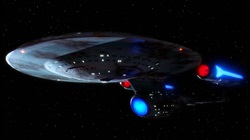
U.S.S. Enterprise NCC-1701-C
U.S.S. Enterprise (NCC-1701-C) Launched in 2332 from Earth Station McKinley, the U.S.S. Enterprise-C was an Ambassador-class heavy cruiser and the fourth Federation starship to bear the name. Under the command of Captain Rachel Garrett, the vessel served as the Federation flagship, introducing the circular saucer and vertical warp core design that bridged the gap between the Excelsior and Galaxy classes.The ship’s legacy was defined by the Narendra III incident in 2344. While patrolling the frontier, the Enterprise responded to a desperate distress call from a Klingon colony under attack by four Romulan Warbirds. Despite being severely outmatched, Garrett engaged the Romulans to protect the civilians. During the battle, a massive explosion combined with a warp field collapse created a temporal rift, into which the vessel vanished.
Declassified reports from the Enterprise-D revealed that the Enterprise-C briefly emerged in an alternate 2366. Realizing their absence in the past had caused a catastrophic Federation-Klingon war, the crew — joined by an alternate-timeline Tasha Yar — voluntarily returned through the rift to fulfill their destiny. By returning to 2344, the Enterprise-C ensured history unfolded correctly. The Klingon High Council was so moved by a Federation flagship dying to defend a Klingon outpost that the act ended decades of hostility and led to the Federation-Klingon Alliance. Though destroyed, the 1701-C remains a symbol of the ultimate price of peace.
 | |
| Affiliation: | United Federation of Planets |
| Class: | Galaxy |
| Service Period: | 2363-2371 2401 |
| Complement: | 1,012 officers and enlisted |
| Fate: | Musuem |
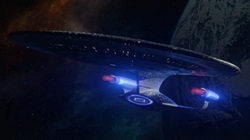
U.S.S. Enterprise NCC-1701-D
The U.S.S. Enterprise-D was a Galaxy-class explorer commissioned in 2363 at the Utopia Planitia Fleet Yards. As the flagship of Starfleet, it represented the zenith of 24th-century technology, housing over 1,000 crew members and their families. Under Captain Jean-Luc Picard, the ship spearheaded critical missions, from the first contact with the Borg Collective to the resolution of the Klingon Civil War.A defining moment occurred in 2366 during the Battle of Wolf 359. After Captain Picard was assimilated as Locutus, the Enterprise — under the temporary command of William Riker — became the primary tactical asset against the Borg. While the fleet suffered devastating losses, the Enterprise crew successfully captured Locutus and utilized his neural link to disable the Borg Cube, preventing the total assimilation of Earth.
The vessel’s initial service ended in 2371 over Veridian III. A battle with a Klingon Bird-of-Prey caused a warp core breach, forcing a saucer separation and a historic crash-landing on the planet Veridian III's surface. While the spaceframe was a total loss, the saucer was covertly recovered by Commodore Geordi La Forge, who restored it using parts from the U.S.S. Syracuse.
In 2401, the resurrected Enterprise-D saved Earth again during the Frontier Day Borg Crisis. Its non-networked systems allowed Picard’s original crew to infiltrate a Borg Cube and destroy its beacon. Following this victory, the 1701-D was officially retired to the Starfleet Fleet Museum at Athan Prime.
 | |
| Affiliation: | United Federation of Planets |
| Class: | Sovereign |
| Service Period: | 2371-2386 |
| Complement: | 855 officers and enlisted |
| Fate: | Destroyed |
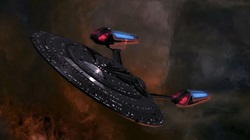
U.S.S. Enterprise NCC-1701-E
The U.S.S. Enterprise-E was a Sovereign-class vessel commissioned in 2372 at the San Francisco Fleet Yards. Originally slated to be named the Honorious, she was renamed to honor the Enterprise-D following its destruction at Veridian III. Under the command of Captain Jean-Luc Picard, the "E" served as the Federation flagship, transitioning Starfleet from the "mobile city" era to a more tactically formidable profile.Though initially assigned to the Romulan Neutral Zone, the Enterprise was an instrumental combatant during the Second Borg Invasion of Earth in 2373. Throughout the Dominion War, the ship balanced heavy diplomatic missions with frontline defense, notably helping to repel the Breen Invasion of Earth. During this period, the crew also uncovered a Starfleet conspiracy within the "Briar Patch." In 2379, the Enterprise deepened relations with the Romulan Star Empire after defeating Praetor Shinzon in the Bassen Rift, though the ship was severely damaged in the exchange.
Following a refit and Captain Picard’s promotion to lead the Romulan Relocation Effort, command passed to Captain Worf in 2381. Under Worf, the Enterprise returned to its exploratory roots but remained at the center of high-profile crises, including the pursuit and capture of the U.S.S. Protostar, during which the vessel sustained significant damage.
The ship’s tenure ended following a diplomatic incident at Kriilar Prime, which led to Worf’s departure from the vessel. After a subsequent classified mission, the Enterprise-E was no longer in service by 2386. While its final fate remains a matter of Starfleet speculation, it is remembered as the "Shield of the Federation" during its most turbulent century.
 | |
| Affiliation: | United Federation of Planets |
| Class: | Odyssey |
| Service Period: | 2386-2401 |
| Complement: | 1,600 officers and enlisted |
| Fate: | Decommissioned |
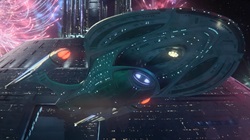
U.S.S. Enterprise NCC-1701-F
U.S.S. Enterprise (NCC-1701-F) The U.S.S. Enterprise-F, an Odyssey-class dreadnought, launched in 2386 from the San Francisco Fleet Yards. As the seventh ship to bear the name, it was designed to project stability during the Romulan Empire's collapse. Under its first commander, Captain Dazad Teagarden, the ship provided critical humanitarian aid following the 2387 supernova, making contact with several formerly conscripted Romulan species.Following its service in former Imperial territory, the Enterprise-F moved to the Alpha Quadrant for deep-space exploration. However, during a mission to rescue Raillian refugees on Fenton IV, a disastrous operation known as the Monfette Gambit severely compromised the ship’s critical systems. Due to the extent of the internal damage, Starfleet scheduled the vessel for early decommissioning during the 250th Frontier Day in 2401.
The ship’s final mission proved harrowing. Under Admiral Elizabeth Shelby, the Enterprise-F was compromised by the Borg-Changeling alliance. It served as the flagship of a conscripted Borg armada, coordinating the devastating assault on Sol Station and Earth. The vessel was only liberated when the crew of the Enterprise-D destroyed the Borg beacon at Jupiter. Following the crisis, the Enterprise-F was officially decommissioned, marking a somber end to the Odyssey era before the name was passed to its successor.
 | |
| Affiliation: | United Federation of Planets |
| Class: | Constitution III |
| Service Period: | 2402-2435 |
| Complement: | 500 officers and enlisted |
| Fate: | Destroyed |
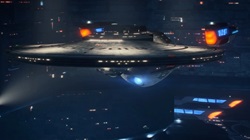
U.S.S. Enterprise NCC-1701-G
The U.S.S. Enterprise-G was a Constitution III-class cruiser commissioned into the lineage in 2402. Originally launched in 2396 as the U.S.S. Titan (NCC-80102-A) under Captain Liam Shaw, the vessel became a legend during the Frontier Day Borg Crisis. Due to the heroism of its crew in assisting the Enterprise-D to thwart the Borg-Changeling alliance, the Titan was rechristened as the Enterprise-G and placed under the command of Captain Seven of Nine.Assigned to deep-space exploration, the "G" surveyed the Beta Quadrant beyond former Romulan territory and served as a vital asset during the Borg War of the 2420s. Following the retirement of Commodore Seven of Nine in 2431, command was transferred to Captain Wilkan Targaryen during the ship's sixth five-year mission. Under Targaryen, the mission was cancelled, and the vessel was recalled to Earth to serve the Federation Diplomatic Corps, transporting the Federation President and Council members on high-priority assignments.
The ship's diplomatic tenure was frequently interrupted by combat, as it became embroiled in several high-profile conflicts, most notably the Vaadwaur Invasion. The Enterprise-G met its end during the Battle of the Foundry, where it was destroyed in the line of duty. Though smaller than the dreadnoughts before it, the 1701-G is remembered for returning the Enterprise name to its roots of bold exploration and frontline diplomacy.
Categories: No categories found