Enterprise Sea-going Vessels
Created by Commodore Wilkan Targaryen on Fri Apr 3rd, 2026 @ 2:44am
Sea-going Earth Vessels
H.M.S. Enterprise |
|
|---|---|
| Affiliation: | France United Kingdom |
| Class: | 24-gun sixth rate |
| Service Period: | 1705-1707 |
| Complement: | 115 officers and enlisted |
| Fate: | Wrecked |
L'Entreprise / H.M.S. Enterprise
The HMS Enterprise (1705) was a 24-gun sixth-rate frigate of the British Royal Navy, notable for being the first vessel in the English service to bear the name. Originally a French naval vessel named L'Entreprise, she was captured by the British in May 1705 during the War of the Spanish Succession.Upon her capture, the ship was brought into the Royal Navy and underwent a brief refit to meet British naval standards. As a sixth-rate frigate, she was designed for speed and agility rather than raw firepower, making her an ideal vessel for scouting, coastal patrol, and the protection of merchant convoys. During her service, she was primarily stationed in the Mediterranean, where she operated as a "cruiser"—a term then used for independent ships tasked with intercepting enemy privateers and maintaining communication lines.
The ship's career was relatively short-lived. In 1707, while performing her duties in the Mediterranean, the Enterprise was driven ashore and wrecked during a severe storm off the coast of Africa. Despite her loss, the vessel's name lived on; the Royal Navy was so impressed by the "enterprising" nature of her service that they commissioned a successor in 1709. This established a continuous naming tradition that has spanned over three centuries of maritime history, influencing both British and American naval heritage.
| Affiliation: | United Kingdom |
| Class: | 44-gun fifth rate |
| Service Period: | 1709-1749 |
| Complement: | 115 officers and enlisted |
| Fate: | Sold |
H.M.S. Enterprise
The HMS Enterprise, launched in 1709, holds a significant place in British naval history as the first vessel purpose-built by the Royal Navy to bear the name. Unlike its predecessor—a captured French frigate—this ship was designed and constructed at the Blackwall Yard as a 44-gun fifth-rate ship-of-the-line.As a fifth-rate, the Enterprise was part of a class of vessels that balanced firepower with maneuverability. Carrying a crew of approximately 190 men, it was primarily utilized for cruising, scouting, and protecting merchant convoys from privateers during the later years of the War of the Spanish Succession. Its 44-gun armament allowed it to engage smaller enemy frigates effectively while maintaining the speed necessary to outrun larger, more heavily armed third-rate ships.
The ship’s career was defined by its reliability in the Mediterranean and the English Channel. It served as a functional blueprint for the "enterprising" spirit the Royal Navy sought to project during the early 18th century. After nearly four decades of service, the vessel was finally hulked and sold in 1749.
The success of the Enterprise solidified the name within the British Admiralty's naming conventions. It transitioned the moniker from a trophy of war into a permanent fixture of the fleet, setting a precedent for the many illustrious ships—both naval and experimental—that would follow in its wake over the next three centuries.
| Affiliation: | Spain United Kingdom |
| Class: | Ex-Barca-longa Sloop |
| Service Period: | 1743-1749 |
| Complement: | 60 officers and enlisted |
| Fate: | Sold |
H.M.S. Enterprize
The HMS Enterprize, commissioned in 1743, represents a unique chapter in the mid-18th-century Royal Navy, primarily due to its origin as a prize of war. Originally a Spanish vessel, it was captured by the British during the War of Jenkins' Ear, a conflict largely fought over Caribbean trade transitions and colonial boundaries.Classified as an 8-gun sloop, the Enterprize was significantly smaller than the fifth-rate frigates that had previously carried the name. As a sloop, it was a unrated vessel, typically commanded by a "Master and Commander" rather than a Post Captain. Its primary role involved dispatch carrying, inshore patrolling, and anti-privateer operations in the Mediterranean and West Indies.
The ship’s armament consisted of eight small carriage guns, likely 3-pounders, supplemented by several swivel guns mounted along the gunwales for close-quarters defense against boarding parties. This configuration made it an ideal "workhorse" for the Admiralty, capable of navigating shallow coastal waters that were inaccessible to larger ships-of-the-line.
The Enterprize served the Royal Navy during a period of intense maritime expansion. While it lacked the heavy broadside capability of its predecessors, its utility in maintaining communication lines between larger fleet elements was vital. The vessel was eventually sold out of service in 1749 following the conclusion of the War of the Austrian Succession, marking the end of its brief but active career under the British flag.
| Affiliation: | United Kingdom |
| Class: | 50-gun fourth rate |
| Service Period: | 1744-1771 |
| Complement: | 115 officers and enlisted |
| Fate: | Decommissioned |
H.M.S. Enterprise
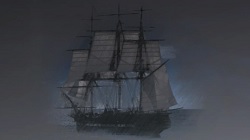
The HMS Enterprise of 1744 represented a significant structural evolution within the Royal Navy’s mid-18th-century fleet. While its lineage traced back to the HMS Norwich, originally launched in 1693, the vessel underwent a comprehensive reconstruction at Chatham Dockyard. Rebuilt according to the 1706 Establishment—a set of standardized naval architecture guidelines—it was relaunched and renamed the Enterprise in 1744.Classified as a fourth-rate ship-of-the-line, the vessel was equipped with 50 guns and designed for the heavy demands of colonial naval warfare. Its initial deployment saw it patrolling the Caribbean during the final years of the War of the Austrian Succession. Following the Treaty of Aix-la-Chapelle in 1748, the Enterprise was placed in the "mothball fleet" (in ordinary), where it remained until the geopolitical climate shifted once more.
With the outbreak of the Seven Years' War in 1756, the ship was recommissioned and assigned to critical Atlantic convoy escort duties, protecting British merchant interests from French privateers. Its most distinguished service occurred in 1762, when it participated in the massive British expedition resulting in the siege and capture of Havana, Cuba.
The Enterprise continued its service until the conclusion of hostilities, eventually being decommissioned in January 1764. As a bridge between the older 17th-century designs and the standardized fleets of the late 1700s, this iteration of the Enterprise solidified the name’s reputation for reliability in global conflict.
 | |
| Affiliation: | United Kingdom |
| Class: | Enterprise |
| Service Period: | 1774-1807 |
| Complement: | 200 officers and enlisted |
| Fate: | Broken Up |
H.M.S. Enterprise
The HMS Enterprise, launched in August 1774, was a landmark vessel for the Royal Navy, serving as the lead ship of the Enterprise-class sixth-rate frigates. Designed by Sir Williams Williams, this class became one of the most successful and numerous frigate designs of the late 18th century, with 27 vessels eventually constructed.As a 28-gun sixth-rate, the Enterprise was built for the specific demands of the American Revolutionary War and the subsequent French Revolutionary Wars. Unlike the larger ships-of-the-line, the Enterprise was designed for independent cruising, privateer hunting, and acting as the "eyes of the fleet." Its hull was 120 feet long, and it carried a primary armament of twenty-four 9-pounder guns on the upper deck, supplemented by four 3-pounders on the quarterdeck.
The vessel’s career was defined by its agility and endurance. It saw extensive service in the Mediterranean and the English Channel, capturing numerous enemy privateers and merchantmen. One of its most notable engagements occurred in 1780, when it captured the Spanish ship San Pantaleon.
Because of its balanced design, the Enterprise served as a reliable platform for younger officers to gain command experience. After nearly thirty years of active service, the ship was finally taken out of commission and stationed at Deptford as a receiving ship in 1791. It was eventually broken up in 1807, but its design influence persisted for decades, cementing the Enterprise name as a symbol of the versatile, independent frigate.
U.S.S. Enterprise |
|
|---|---|
| Affiliation: | United Kingdom United States of America |
| Class: | Sloop-of-war |
| Service Period: | 1775-1777 |
| Complement: | 50 officers and enlisted |
| Fate: | Destroyed |
H.M.S. Enterprize / U.S.S. Enterprise
The USS Enterprise of 1775 marks the beginning of the storied American naval tradition for the name. Originally a British supply sloop named George, the vessel was captured by Colonel Benedict Arnold and a small contingent of Continental forces in May 1775 during a daring raid on St. Johns, Quebec.Following its capture, the sloop was armed with twelve 4-pounder guns and renamed Enterprise. As the primary capital ship of the newly formed Lake Champlain Squadron, it played a vital role in the early stages of the American Revolutionary War. Under the command of Arnold, the Enterprise was instrumental in maintaining American control of the strategic Lake Champlain waterway, preventing British forces from splitting the colonies via a southern thrust from Canada.
The vessel’s most significant contribution occurred during the Battle of Valcour Island in October 1776. While the American fleet suffered heavy losses against a superior British force, the Enterprise and its sister ships succeeded in delaying the British advance for an entire year, providing the Continental Army with critical time to prepare for the eventual victory at Saratoga.
To prevent the ship from falling back into enemy hands, the Enterprise was run aground and burned by its own crew in July 1777 at Whitehall, New York. Though its service lasted only two years, this "First Enterprise" established the name as a symbol of American defiance and strategic ingenuity.
| Affiliation: | United States of America |
| Class: | Schooner |
| Service Period: | 1776-1777 |
| Complement: | 60 officers and enlisted |
| Fate: | Decommissioned |
Enterprise
USS Enterprise (1776) The second American vessel to bear the name, the USS Enterprise of 1776, was a small, agile schooner purchased by the Continental Navy to bolster the defense of the American coastline during the Revolutionary War. Unlike its contemporary namesake serving on Lake Champlain, this Enterprise was dedicated to maritime security and the protection of vital supply lines along the Atlantic seaboard.Armed with ten small carriage guns and a crew of approximately 60 men, the schooner was ideally suited for the littoral waters of the Chesapeake Bay. Under the command of Captain James Campbell, the vessel’s primary mission was to serve as a convoy escort for American merchant ships and to provide reconnaissance against British naval movements. During a period when the Continental Navy was severely outmatched by the British Royal Navy, smaller "mosquito fleet" vessels like the Enterprise were essential for maintaining domestic commerce.
The Enterprise was notably active in the defense of Baltimore and the surrounding Maryland coastline. Its presence acted as a deterrent against smaller British raiders and Tory privateers seeking to disrupt the flow of goods to the Continental Army.
The schooner’s formal service to the Continental Navy concluded in 1777, when it was returned to the Maryland Council of Safety. Although its tenure was brief and localized compared to the "Big E" carriers of the future, the 1776 Enterprise played a foundational role in the early American strategy of asymmetrical coastal defense, proving that even a small vessel could provide outsized strategic value during the nation's struggle for independence.
H.M.S. Enterprise |
|
|---|---|
| Affiliation: | France United Kingdom |
| Class: | Corvette |
| Service Period: | 1794-1807 |
| Fate: | Scrapped |
L'Entreprise/H.M.S. Enterprise
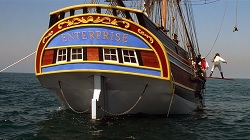
The L'Entreprise of 1794 was a small, fast armed vessel—typically classified as an aviso or corvette—of the French Revolutionary Navy. Built during a period of radical naval expansion and internal upheaval in France, she was designed for the high-speed delivery of orders, coastal reconnaissance, and the harassment of merchant shipping.Armed with approximately 6 to 10 small-caliber cannons, L'Entreprise lacked the firepower to engage in major line-of-battle fleet actions. Instead, her value lay in her agility. During the French Revolutionary Wars, vessels like L'Entreprise were essential for maintaining communication between the scattered French ports and the revolutionary government in Paris, often slipping through the tight British blockades that choked the French coastline.
Her service under the Tricolor was notably brief. In May 1795, while operating in the Mediterranean, she was intercepted and captured by the British 32-gun frigate HMS Lowestoffe. Following the custom of the era, the Royal Navy prize crew brought her into British service.
Renamed HMS Entreprise, she served the British Admiralty for another decade. She was eventually sold out of the service in 1807. While she was one of the smaller vessels to bear the name, her capture and subsequent service reinforced the long-standing maritime tradition of the British Royal Navy adopting "Enterprise" from French prizes, further cementing the name's status as a symbol of captured prestige and tactical utility.
 | |
| Affiliation: | United States of America |
| Class: | Schooner |
| Service Period: | 1799-1823 |
| Complement: | 70 officers and enlisted |
| Fate: | Destroyed |
U.S.S. Enterprise
The USS Enterprise of 1799 is one of the most celebrated vessels in early American naval history, earning the nickname "The Lucky Little Enterprise" for its survival through numerous engagements. Built at Henry Spencer's shipyard in Baltimore, Maryland, it was originally commissioned as an 12-gun schooner before being re-rigged as a brig in 1811.The vessel gained national fame during the First Barbary War (1801–1805). Under the command of Lieutenant Andrew Sterett, the Enterprise defeated the Tripolitan ship Tripoli in August 1801 without losing a single American life. This engagement saw the Enterprise fire the first shots of the conflict, proving the effectiveness of the young United States Navy against the Barbary pirates.
During the War of 1812, the Enterprise continued its streak of success. In September 1813, commanded by Lieutenant William Burrows, the ship engaged and captured the British brig HMS Boxer off the coast of Maine. Though both commanders were mortally wounded in the fierce exchange, the victory provided a significant morale boost to the American public.
The Enterprise served the Navy for an unprecedented 24 years, a remarkable lifespan for a wooden vessel of that era. Its duties ranged from Mediterranean combat to suppressing piracy and the slave trade in the Caribbean. The ship’s long and decorated career finally came to an end when it was wrecked on Little Curaçao Island in the West Indies in 1823. The 1799 Enterprise remains a cornerstone of naval lore, representing the transition of the U.S. Navy into a global maritime power.
| Affiliation: | United Kingdom |
| Class: | Enterprise |
| Service Period: | 1806-1816 |
| Complement: | 200 officers and enlisted |
| Fate: | Sold |
H.M.S. Enterprise
The HMS Enterprise of 1806 represents a stationary yet vital chapter in the Royal Navy’s Napoleonic-era logistics. The vessel was originally launched in 1778 as the HMS Resource, a 28-gun Enterprise-class sixth-rate frigate. After nearly three decades of active blue-water service, including engagements in the American Revolutionary War and the French Revolutionary Wars, the aging ship was withdrawn from frontline combat.In April 1806, the Admiralty rechristened the vessel as the Enterprise. Rather than returning to the open sea, she was permanently moored on the River Thames at the Tower of London. In this secondary role, the Enterprise served as a receiving ship and a floating depot. Her primary function was to act as a base for the Impress Service, housing newly recruited or pressed sailors before they were drafted onto active warships heading for the front lines against Napoleon's fleet.
Stripped of her tall masts and rigged with a simple housing over her deck, the Enterprise became a familiar landmark of the London waterfront. While she no longer chased privateers or fired broadsides, her role was essential for maintaining the massive manpower requirements of the Royal Navy during the height of the global conflict.
The ship remained at her station by the Tower for a decade, serving through the conclusion of the Napoleonic Wars. Her long service finally ended in 1816, when she was sold to be broken up, marking the retirement of one of the original hulls from the successful 1774 design class.
| Affiliation: | United States |
| Class: | Steamboat |
| Service Period: | 1814-1816 |
| Fate: | Abandoned |
Enterprise
The Enterprise of 1814 was a pioneering American steamboat that played a decisive logistical role in the War of 1812. Built in Brownsville, Pennsylvania, by the Monongahela and Ohio Steam Boat Company, she was a small, high-pressure vessel designed to prove that steam power could conquer the powerful currents of the Mississippi River.In December 1814, under the command of Captain Henry Miller Shreve, the Enterprise was pressed into military service by General Andrew Jackson. As British forces threatened to seize New Orleans, the city faced a desperate shortage of gunpowder and small arms. The Enterprise successfully ran a British naval blockade to deliver a massive shipment of ordnance and supplies from upriver, arriving just in time for the climactic Battle of New Orleans in January 1815.
Following the American victory, the Enterprise achieved another historic milestone: she became the first steamboat to make the grueling return trip from New Orleans to Cincinnati. By proving that a vessel could travel against the river's current, she effectively triggered the "Steamboat Age," transforming the American interior into a global economic engine.
The Enterprise met a quiet end in 1816 when she was abandoned after hitting a snag in the river, but her legacy of "bold undertaking" lived on. Her successful military transport and revolutionary navigation of the Mississippi cemented the name Enterprise as a symbol of American ingenuity and grit during the nation’s formative years.
| Affiliation: | United Kingdom |
| Class: | Wooden Paddle Gunvessel |
| Service Period: | 1824-1830 |
| Complement: | 50 officers and enlisted |
| Fate: | Decommissioned |
H.M.S. Enterprise
The HMS Enterprise of 1824 represents the Royal Navy’s early transition from traditional sail to steam propulsion. Purchased by the British Admiralty in 1824, this vessel was a wooden paddle gunvessel, a cutting-edge experimental design for the post-Napoleonic era.Unlike the sprawling ships-of-the-line, the 1824 Enterprise was a smaller, specialized craft equipped with side-mounted paddle wheels. This propulsion system allowed the vessel to maneuver independently of wind conditions, making it invaluable for towing larger ships in and out of harbors, navigating narrow estuaries, and performing coastal defense duties where sail-driven ships might become becalmed.
Armed with a modest complement of carriage guns, the Enterprise served as a proof-of-concept for the future of steam-assisted warfare. During its six years of active service, the vessel was utilized primarily for packet service and general harbor duties, demonstrating the reliability of steam power in the challenging waters of the English Channel and the North Sea.
While the "Age of Steam" was still in its infancy, the 1824 Enterprise provided the Admiralty with critical data regarding coal consumption, mechanical maintenance, and the integration of paddle wheels into naval architecture. The vessel remained in service until 1830, when it was eventually sold out of the Royal Navy. Though its career was relatively brief, it served as a vital bridge between the era of wooden sailing frigates and the ironclad steamships that would dominate the mid-19th century.
| Affiliation: | United States of America |
| Class: | Schooner |
| Service Period: | 1831-1844 |
| Complement: | 72 officers and enlisted |
| Fate: | Sold |
U.S.S. Enterprise
The USS Enterprise of 1831 was a 10-gun wooden schooner built at the New York Navy Yard. Designed for speed and shallow-water maneuverability, this iteration of the Enterprise was a key asset in the United States Navy’s transition toward global maritime policing during the mid-19th century.Launched in October 1831, the vessel was primarily deployed to the Brazil Station and the East Indies. Its mission was twofold: protecting American commercial interests and, most notably, participating in the international effort to suppress the illegal African slave trade. The schooner’s sleek design allowed it to pursue the fast, agile slave ships that frequently attempted to evade larger, slower warships in coastal inlets.
Under the command of officers like Lieutenant George N. Hollins, the Enterprise conducted extensive patrols along the coast of South America and through the Indian Ocean. In 1835, it became one of the first American vessels to visit the port of Cochin, India, as part of a diplomatic and scientific circumnavigation of the globe.
Throughout its decade of service, the Enterprise proved the utility of small, well-armed schooners in maintaining international law. After years of continuous tropical service, the ship’s hull eventually fell victim to significant decay. It was decommissioned and sold at the Boston Navy Yard in 1844, concluding a career defined by humanitarian enforcement and the expansion of American naval diplomacy.
| Affiliation: | United Kingdom |
| Class: | Arctic Discovery Ship |
| Service Period: | 1848-1903 |
| Complement: | 100 officers and enlisted |
| Fate: | Sold |
H.M.S. Enterprise
The HMS Enterprise of 1848 was a wooden screw-propelled discovery ship that played a central role in one of the most famous maritime mysteries of the 19th century: the search for Sir John Franklin’s lost Arctic expedition. Originally designed as a merchant vessel, she was purchased by the Royal Navy and specifically reinforced with iron plating and heavy internal timbering to withstand the crushing force of Arctic pack ice.Launched in April 1848, the Enterprise was first commanded by Sir James Clark Ross. Her maiden voyage to the Arctic (1848–1849) was the first official Admiralty search mission sent to locate Franklin's ships, Erebus and Terror. Although this initial voyage did not find the missing explorers, it provided invaluable mapping of the treacherous Canadian Arctic Archipelago.
Between 1850 and 1855, the Enterprise undertook a second, even more grueling mission under the command of Richard Collinson. Entering the Arctic via the Pacific and the Bering Strait, the ship spent over three years locked in the ice or navigating uncharted leads. During this expedition, Collinson's crew came within a short distance of the location where Franklin’s ships had been abandoned, though they were unable to confirm the discovery at the time.
The 1848 Enterprise proved to be an exceptionally sturdy vessel, surviving years of extreme polar conditions that claimed many other ships. After her return to England, she was utilized for various secondary duties before being lent to the Commissioners of Northern Lighthouses. She was eventually sold in 1903, ending a career defined by endurance and scientific exploration.
| Affiliation: | United Kingdom |
| Class: | Ironclad Sloop |
| Service Period: | 1864-1885 |
| Complement: | 130 officers and enlisted |
| Fate: | Scrapped |
H.M.S. Enterprise
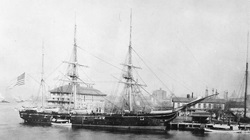
The HMS Enterprise of 1864 represented a pivotal era of naval experimentation, marking the Royal Navy’s transition from traditional wooden hulls to armored ironclads. Launched at the Deptford Dockyard, this vessel was the seventh British ship to bear the name and served as a primary example of the rapid technological shifts occurring in the mid-19th century.Originally laid down as a wooden screw sloop of the Camelion class, the ship’s design was fundamentally altered mid-construction by the Chief Constructor of the Navy, Edward Reed. Under his direction, the Enterprise was completed as a central battery ironclad. This innovative design concentrated the ship’s heavy armament—four 7-inch muzzle-loading rifled guns—within a central armored "box" or citadel, providing superior protection and a wider field of fire compared to traditional broadside arrangements.
Despite being a relatively small vessel with a displacement of approximately 1,350 tons, the Enterprise was a capable wooden-hulled ironclad. She spent the vast majority of her active career assigned to the Mediterranean Fleet, where her armored protection and steam propulsion made her a formidable presence in regional diplomacy and coastal defense.
After years of overseas service, the Enterprise returned to England in 1871, where she was paid off and placed into the reserve. As naval architecture continued to advance toward all-steel battleships, the hybrid wooden-ironclad design became obsolete. The vessel remained in ordinary until 1885, when she was finally sold for scrap, concluding twenty-one years of service at the dawn of the modern armored navy.
 | |
| Affiliation: | United States of America |
| Class: | Screw Sloop |
| Service Period: | 1874-1910 |
| Complement: | 184 officers and enlisted |
| Fate: | Scrapped |
U.S.S. Enterprise
The USS Enterprise, launched in 1874 at the Portsmouth Navy Yard, was a wooden-hulled, steam-powered bark-rigged sloop-of-war. Representing the transitional "Old Navy" of the post-Civil War era, the vessel combined traditional sail power with a coal-fired engine, providing the range and reliability required for extended global deployments.While the ship was armed with a battery of 8-inch smoothbore guns and 60-pounder rifles, its primary contribution to naval history was scientific rather than martial. Between 1883 and 1886, under the command of Commander Albert S. Barker, the Enterprise undertook a remarkable three-year circumnavigation of the globe. During this mission, the crew performed extensive hydrographic surveys and deep-sea soundings, significantly advancing the world’s understanding of ocean floor topography in the Atlantic and Indian Oceans.
Following its surveying years, the Enterprise transitioned into a vital educational role. In 1892, it was lent to the Commonwealth of Massachusetts to serve as a training ship for the newly established Massachusetts Nautical Training School (now the Massachusetts Maritime Academy). For seventeen years, the vessel served as a floating classroom, training generations of officers for the American merchant marine and navy.
The 1874 Enterprise remained a fixture of New England maritime education until 1909, when it was finally decommissioned and sold for scrap. Its legacy is one of peace and preparation, bridging the gap between the era of wooden sailing ships and the professionalized, scientific navy of the 20th century.
| Affiliation: | United States of America |
| Class: | Motorboat |
| Service Period: | 1917-1919 |
| Complement: | 8 personnel |
| Fate: | Decommissioned |
Enterprise SP-790
The USS Enterprise (SP-790) represents a unique departure from the massive warships that typically carry the name. During the United States' entry into World War I, the Navy faced an urgent need for small, fast vessels to patrol coastal waters and harbors against potential sabotage or submarine threats. To meet this demand, the Navy acquired hundreds of civilian pleasure craft under the "Section Patrol" (SP) program.Originally a private motorboat built in 1914 by the Great Lakes Boat Building Corporation, the Enterprise was a sleek, 66-foot wooden-hulled vessel. In 1917, she was leased from her owner, G.L. Hanna of Cleveland, Ohio, and commissioned into the U.S. Navy for the duration of the conflict.
Armed with two machine guns and a small crew, the Enterprise was assigned to the 2nd Naval District, based out of Newport, Rhode Island. Her primary duties included harbor defense, patrolling the Narragansett Bay, and serving as a dispatch boat for the naval station. While she lacked the heavy armament of a destroyer, her maneuverability made her an effective deterrent in the crowded littoral waters of the Northeast.
Following the signing of the Armistice, the Navy's need for a vast auxiliary fleet diminished. The Enterprise was decommissioned and returned to her original owner in May 1919. Though her naval career was brief and her scale was small, SP-790 ensured the continuity of the Enterprise name during the first great global conflict of the 20th century.
 | |
| Affiliation: | United Kingdom |
| Class: | Emerald |
| Service Period: | 1919-1946 |
| Complement: | 572 officers and enlisted |
| Fate: | Scrapped |
H.M.S. Enterprise (D52)
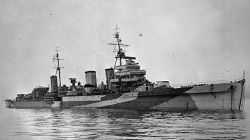
The HMS Enterprise (D52), an Emerald-class light cruiser, was one of the fastest and most enduring vessels of the Royal Navy during the mid-20th century. Launched in 1919 and commissioned in 1926, she was a product of lessons learned during World War I, designed with a high-speed hull and a unique experimental twin 6-inch gun turret forward—a feature that would become standard on later British cruiser classes.During World War II, the Enterprise served across nearly every major theater of operation. In 1940, she participated in the Norwegian Campaign and later joined "Force H" in the Mediterranean. One of her most notable achievements occurred in December 1943 during the Battle of the Bay of Biscay, where, alongside HMS Glasgow, she engaged and defeated a superior force of German destroyers and torpedo boats despite heavy seas.
In June 1944, the Enterprise provided critical naval gunfire support during the Normandy Landings (D-Day), targeting German coastal defenses at "Omaha" and "Utah" beaches. Her 6-inch guns were instrumental in suppressing enemy strongpoints to protect the Allied advance inland. Throughout the war, she also completed numerous high-stakes gold bullion transports and Atlantic convoy escorts.
By the end of hostilities in 1945, the Enterprise had steamed over 275,000 miles. Having survived two decades of service and the entirety of the Second World War, she was finally decommissioned and sold for scrap in 1946. Her legacy is one of remarkable versatility, transitioning from a post-WWI experimental design to a decorated veteran of modern naval warfare.
 | |
| Affiliation: | United States of America |
| Class: | Yorktown |
| Service Period: | 1936-1947 |
| Complement: | 2,217 officers and enlisted |
| Fate: | Decommissioned |
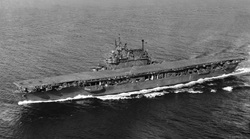
U.S.S. Enterprise CV-6
The USS Enterprise (CV-6), famously known as the "Big E," was a Yorktown-class aircraft carrier and remains the most decorated ship in the history of the United States Navy. Launched in 1936 and commissioned in 1938, she was one of only three American carriers built before the war to survive the entirety of World War II.The Enterprise was at sea during the attack on Pearl Harbor and quickly became the backbone of the Pacific Fleet. She played a pivotal role in nearly every major engagement of the Pacific War, including the Battle of Midway, where her dive bombers delivered the decisive blows against the Imperial Japanese Navy. From the grueling Solomon Islands campaign and Guadalcanal to the Great Marianas Turkey Shoot and the Battle of Leyte Gulf, the Enterprise was a constant, defiant presence.
Her resilience earned her a unique distinction: at one point in 1942, after the loss of her sister ships, the crew famously posted a sign on the flight deck reading, "Enterprise vs. Japan." By the end of the war, she had earned 20 Battle Stars, a Presidential Unit Citation, and the Navy Unit Commendation.
Despite her legendary status and a massive public campaign to save her as a museum, the Enterprise was decommissioned in 1947 and sold for scrap in 1958. Though her steel was recycled, her name became synonymous with naval excellence, ensuring that every subsequent "Enterprise" would carry the weight of her unmatched combat legacy.
 | |
| Affiliation: | United Kingdom |
| Class: | Echo |
| Service Period: | 1959-1985 |
| Complement: | 18 officers and enlisted |
| Fate: | Scrapped |
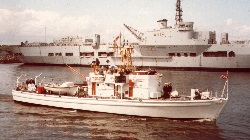
H.M.S. Enterprise (A71)
HMS Enterprise (A71) The HMS Enterprise (A71), launched in 1959, was an Echo-class inshore survey vessel built for the Royal Navy by William Denny & Brothers. Designed specifically for hydrographic surveying and oceanographic research, this iteration of the Enterprise represented the Admiralty’s post-war commitment to scientific maritime exploration and the safety of global shipping lanes.With a displacement of 160 tons and a length of 106 feet, the A71 was smaller and more specialized than the combat cruisers that previously bore the name. Its primary mission involved detailed mapping of the English Channel and the North Sea, ensuring that shifting sandbanks and underwater obstructions were accurately recorded for both naval and merchant fleets. The vessel was equipped with the latest sounding equipment of the era, allowing for high-precision coastal charts.
The ship’s career was defined by its consistent, quiet utility. Unlike the "Big E" or the legendary frigates of the 18th century, the 1959 Enterprise served a humanitarian and navigational role, preventing maritime disasters through scientific rigor. It operated as part of the Hydrographic Squadron, often working in tandem with its sister ships, Echo and Egeria.
After nearly three decades of service, the Enterprise was decommissioned in 1985. It was subsequently sold to a private owner and renamed Beal, ending its tenure as a commissioned naval vessel. Though it lacked the heavy armament of its predecessors, the A71 maintained the name’s legacy of "bold undertaking" by navigating the complex and dangerous littoral waters of the British Isles.
 | |
| Affiliation: | United States of America |
| Class: | Enterprise |
| Service Period: | 1961–2012 |
| Complement: | 5,828 officers and enlisted |
| Fate: | Decommissioned |
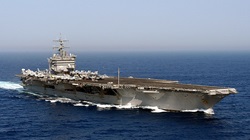
U.S.S. Enterprise CVN-65
The USS Enterprise (CVN-65) made naval history as the world’s first nuclear-powered aircraft carrier. Commissioned in November 1961, she was the largest ship ever built at the time, earning the nickname "Big E" from her illustrious predecessor. Powered by an unprecedented eight nuclear reactors, she possessed virtually unlimited range and high-speed endurance without the need for conventional refueling.Her career spanned over five decades of American maritime dominance. The Enterprise was a centerpiece of the U.S. Navy during the Cuban Missile Crisis of 1962, where she participated in the naval blockade of Cuba. Throughout the Vietnam War, she served multiple combat tours, launching thousands of sorties from Yankee Station. In the following decades, she remained a constant presence in the Persian Gulf and participated in the opening strikes of Operation Enduring Freedom following the September 11 attacks.
Technologically, the CVN-65 was a marvel, featuring the SCANFAR phased-array radar system and a flight deck spanning over four acres. Her massive silhouette and unique square island became iconic symbols of the Cold War and the atomic age.
After 51 years of continuous service—the longest of any U.S. aircraft carrier—the Enterprise was inactivated in 2012 and officially decommissioned in 2017. Her legacy as a pioneer of nuclear propulsion ensured that the name Enterprise remained at the forefront of naval innovation into the 21st century.
 | |
| Affiliation: | United Kingdom |
| Class: | Echo |
| Service Period: | 2003-2023 |
| Complement: | 72 officers and enlisted |
| Fate: | Decommissioned |
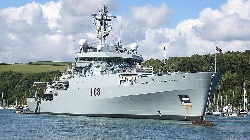
H.M.S. Enterprise H88
The HMS Enterprise (H88) is an Echo-class multi-role survey vessel (hydrographic/oceanographic) of the Royal Navy. Launched in 2002 and commissioned in 2003, she was designed to provide the fleet with high-end environmental data, utilizing advanced sonar and a small survey motor boat for shallow-water operations.While her primary designation was scientific, the H88 became famous for her extensive humanitarian and diplomatic missions. In 2014, she played a critical role in the evacuation of British citizens from Libya during the civil war. Shortly after, she was deployed to the Mediterranean as part of Operation Sophia, where her crew rescued thousands of migrants from unseaworthy vessels, earning the ship a reputation for lifesaving alongside her technical duties.
Technologically, the Enterprise was a pioneer for the Royal Navy, being one of the first ships to utilize Azipod propulsion—thrusters that can rotate 360 degrees—giving her extraordinary maneuverability in tight harbors and when holding station for deep-sea mapping. Her sensors allowed for the creation of 3D maps of the ocean floor in real-time, providing vital data for submarine navigation and mine countermeasures.
After two decades of versatile service that spanned from the South Atlantic to the Persian Gulf, the Enterprise was decommissioned in March 2023. Her retirement marked the end of the Echo class in the Royal Navy, as the service transitioned toward autonomous underwater vehicles for future hydrographic mapping.
 | |
| Affiliation: | United States of America |
| Class: | Gerald R. Ford |
| Service Period: | 2028-2063 |
| Complement: | 4,660 officers and enlisted |
| Fate: | Museum |
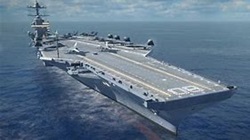
U.S.S. Enterprise CVN-80
The USS Enterprise (CVN-80) is the ninth United States naval vessel and third aircraft carrier to bear the name, commissioned in 2028 as the third Gerald R. Ford-class ship. Built with steel recycled from CVN-65, she entered service just as the world descended into the chaos of the Second American Civil War and the Eugenics Wars. Much of the vessel's history has been lost to the ravages of World War III (2026–2053); however, fragmented records confirm her involvement in several major campaigns during these global conflicts, serving as a critical command platform for Allied forces against the Eastern Coalition (ECON) and the rise of genetically engineered Augments.Throughout the "fights for freedom" and the mid-21st-century nuclear exchanges, the Enterprise acted as a bastion of naval power, utilizing her high-mobility nuclear propulsion and Electromagnetic Aircraft Launch System (EMALS) to maintain a strategic advantage. Following the conclusion of World War III, the battle-scarred vessel was preserved as a testament to human resilience. She was converted into a museum ship in New York City, where she replaced the Intrepid as a permanent fixture of the Manhattan skyline. This legacy of survival through Earth’s darkest era directly inspired the naming of the NX-01, ensuring the "Big E" lineage would transition from the oceans of Earth into the final frontier.
 | |
| Affiliation: | United Kingdom |
| Class: | Type 31 |
| Service Period: | 2028-2034 |
| Complement: | 110 officers and enlisted |
| Fate: | Destroyed |
H.M.S. Enterprise
The HMS Enterprise (F188) was a Type 31 Inspiration-class frigate commissioned in 2028, representing the Royal Navy’s commitment to a versatile, forward-deployed surface fleet. Named to honor the "spirit of bold undertaking," she entered service just as the world descended into the chaos of the Second American Civil War and the global instability of the Eugenics Wars.As the opening salvos of World War III (2026–2053) fractured international alliances, the F188 became a critical asset for the United Kingdom and Western interests against the Eastern Coalition (ECON). In 2034, during a high-stakes escort mission in the North Atlantic, the Enterprise was ambushed by a superior ECON strike group supported by genetically engineered Augment insurgents. Despite a defiant defense using her Sea Ceptor missile system and automated 57mm cannons, the frigate was overwhelmed by a coordinated saturation attack.
The Enterprise took multiple anti-ship missile impacts and was eventually destroyed in a catastrophic magazine explosion, sinking with nearly all hands. Though the physical vessel was lost, the story of her final stand against the "fights for freedom" became a rallying cry for the Allied fleet. This legacy of maritime sacrifice through Earth’s darkest era directly influenced the naming of the first Warp 5 starship, NX-01, ensuring the Enterprise lineage would rise from the radioactive oceans of Earth into the final frontier.
Categories: No categories found